WELLINGTON, 31 July 2026
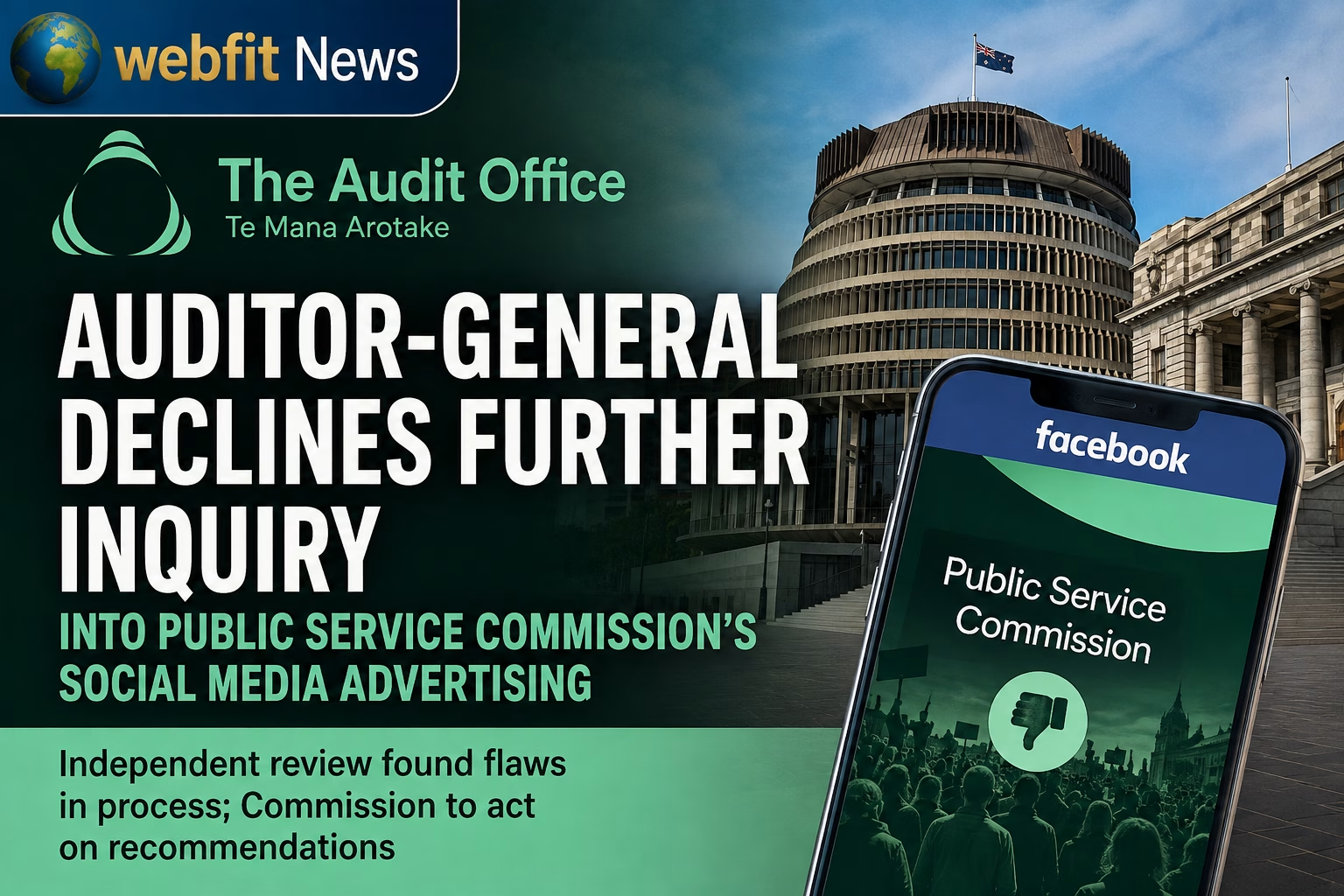
The Auditor-General will not open a separate inquiry into the Public Service Commission’s controversial social media advertising campaign during public sector industrial action in October 2025.
The Audit Office confirmed its decision after reviewing the findings of an independent external examination commissioned by the Public Service Commission, Te Kawa Mataaho.
That review identified several weaknesses in the Commission’s decision-making process and recommended changes to improve how politically sensitive communications are assessed and approved.
The Commission has accepted the findings and published the steps it intends to take in response.
The Audit Office said conducting further work would likely repeat the independent review without providing sufficient additional value.
Request came from Labour MP Camilla Belich
The matter arose after Labour MP Camilla Belich asked the Auditor-General to investigate the Commission’s decision to purchase social media advertisements relating to industrial action by public sector unions.
The advertisements were published during a period of heightened tension between public sector employers and workers in health, education and other government services.
Questions were raised about whether it was appropriate for the Commission to use paid social media messaging during an industrial dispute and whether the material was consistent with the political neutrality expected of the Public Service.
In December 2025, the Audit Office advised that it would wait for the Commission’s independent review to be completed before deciding whether its own investigation was necessary.
That review has now concluded.
Independent review found problems with the process
The external review did not find that the Commission’s advertisements breached political neutrality.
However, it concluded that the decision-making process was not sufficiently careful for a high-risk and contentious communications campaign.
The review found that the Commission moved too quickly, did not spend enough time considering integrity advice and failed to fully examine how short-form paid social media posts could be understood without the context provided through longer media statements or interviews.
It also found that internal concerns were not elevated as clearly as they should have been and that the approval process lacked sufficient rigour.
The review made several recommendations, including allowing more time for integrity analysis, strengthening sign-off procedures and considering independent peer review when agencies are making decisions involving their own conduct.
Audit Office says further work would duplicate review
After considering the findings, the Audit Office decided that a separate inquiry was not required.
“Given the findings in the review, and the steps being taken by the Commission, we consider further work by our Office would likely duplicate the work done in the review and is not necessary,” the Audit Office said.
The decision does not amount to an endorsement of the original advertising campaign.
Instead, the Audit Office appears satisfied that the independent review identified the main issues and that the Commission has committed to responding to them.
The Auditor-General has encouraged the Commission to implement those actions swiftly.
It has also urged other public organisations to consider the review’s findings when planning communications on politically sensitive or contentious matters.
Commission under pressure to demonstrate improvement
The Public Service Commission has acknowledged that the campaign should have been handled with greater care.
Public Service Commissioner Sir Brian Roche has said the Commission was entitled to communicate in its role as an employer during collective bargaining, but accepted that the process moved too quickly.
The Commission maintains that there was no direction from Ministers to undertake the advertising campaign and that the advertisements did not breach political neutrality.
However, the review showed that avoiding a formal breach is only one part of the standard expected from a central public service institution.
The Commission is responsible for providing leadership across the Public Service on integrity, conduct and political neutrality.
That role means its own decisions are likely to face a higher level of scrutiny, particularly when it becomes directly involved in an industrial dispute.
Paid advertising created additional risks
Paid social media advertising carries different risks from ordinary media statements.
A media release or interview can explain the background to a dispute and clarify the role in which an official is speaking.
A short advertisement may be seen without that context.
It can also be targeted at particular audiences, repeatedly displayed and shared outside the original setting.
The independent review found that these factors were not considered carefully enough before the Commission’s campaign was launched.
The issue was not simply whether the information in the advertisements was accurate.
The Commission also needed to consider whether the format and timing could create a perception that the Public Service was campaigning against striking workers.
PSA says review validates union concerns
The Public Service Association has argued that the independent review supports concerns it raised when the advertisements were published.
The union says Commission staff warned about political neutrality and reputational risks but those concerns were not adequately resolved before the campaign went ahead.
The PSA has also criticised the Commission for using paid advertising during collective bargaining, arguing that the focus should have been on resolving workers’ concerns rather than publicly promoting the employer’s position.
Although the Audit Office will not undertake a further inquiry, the Commission is likely to remain under pressure from unions and political parties to show that its new safeguards are meaningful.
Why the Auditor-General’s decision matters
The Controller and Auditor-General is an independent Officer of Parliament and cannot be directed by the Government of the day.
The Audit Office examines how public organisations use public resources, make decisions and remain accountable to Parliament and the public.
Its decision not to investigate further means the independent review will remain the principal examination of the Commission’s advertising campaign.
However, the Audit Office’s response also places responsibility firmly back on the Commission.
The Commission must now demonstrate that the review’s recommendations are implemented rather than simply acknowledged.
Lessons extend across the public sector
The Audit Office has encouraged all public organisations to examine the report.
That message is important because government departments, councils and Crown entities increasingly use social media to communicate directly with the public.
The speed of digital publishing can create pressure to approve campaigns quickly, especially during disputes or fast-moving events.
But the risks are greater when an agency is communicating about a matter in which it has a direct interest.
Public organisations must consider legal authority, factual accuracy, political neutrality, public perception and the integrity of their approval processes.
The Commission’s experience shows that asking whether an organisation can publish a message is not enough.
Decision-makers must also ask whether they should publish it, whether the chosen format is appropriate and whether the process can withstand later public scrutiny.
Focus now shifts to implementation
The Audit Office’s decision closes the possibility of an immediate separate inquiry, but it does not close the wider debate.
The Commission’s credibility will now depend on how quickly and effectively it improves its communications governance.
The independent review identified the weaknesses.
The Commission has promised corrective action.
The Auditor-General has decided that duplicating that work is unnecessary.
The next test will be whether future decisions show that the lessons have genuinely been learned.