WELLINGTON, 22 July 2026
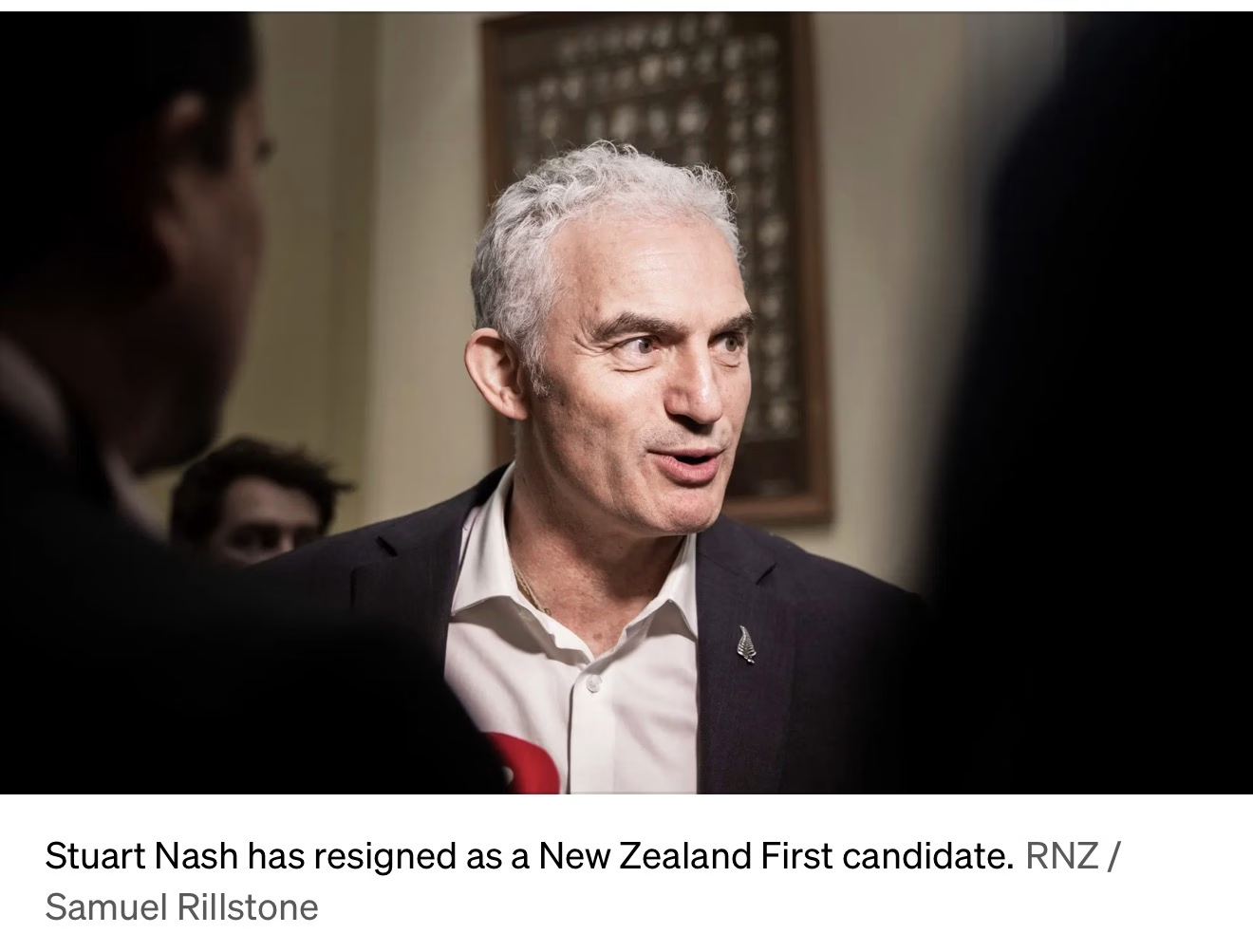
Former Labour minister Stuart Nash has resigned as a New Zealand First candidate after facing widespread criticism over comments directed at National’s Napier MP Katie Nimon.
New Zealand First leader Winston Peters confirmed Nash’s departure in a short statement posted on social media late on Wednesday night.
“Stuart Nash has offered his resignation as a candidate and we have accepted,” Peters said, according to RNZ.
The decision brings a sudden end to Nash’s attempted political comeback only weeks after New Zealand First formally presented him as its candidate for the Napier electorate.
Fake “New Zealand-Based” Online Stores Are Fooling Kiwi Shoppers – WebfitNews
Comments about Katie Nimon sparked backlash
The controversy began after Nash criticised Nimon’s record as Napier MP and described her as lazy for allegedly taking nine months away from work while continuing to receive her full salary.
However, Nimon had reportedly taken around six months away from Parliament following the birth of her baby.
The remarks were strongly condemned across Parliament, with political leaders accusing Nash of attacking a female MP for taking maternity leave.
Prime Minister Christopher Luxon described the comments as sexist and said Nash appeared to be “channelling the manosphere”.
The criticism quickly shifted from a disagreement about political performance to a wider debate about maternity leave, working parents and the standards expected from election candidates.
Luxon rules out Nash as a future minister
Before Nash’s resignation was formally announced, Luxon stated that Nash would not serve as a minister in any government led by him.
“Whether reports of Stuart Nash’s resignation as a NZ First candidate are true or not, I am making clear he will not serve as a minister in my government,” Luxon wrote on social media.
Luxon said Nash had been involved in several incidents of poor behaviour and argued that his latest response showed a lack of genuine remorse.
The prime minister’s statement was politically significant because New Zealand First could potentially play a role in forming a future government.
Until this controversy, Nash had been presented as someone with previous Cabinet experience who could potentially return to a senior position if New Zealand First entered government after the election.
New Zealand First had publicly promoted Nash as its Napier candidate in June, with Peters highlighting his experience and connection to Hawke’s Bay.
Nash defends focus on political performance
In a statement issued earlier on Wednesday, Nash said his comments were intended to focus on political performance and who had delivered results for Napier.
He said he was prepared to be judged on his own work ethic, achievements and record in the electorate.
Nash also said he respected working parents who were raising newborn children while managing demanding careers.
He pointed to his involvement in a previous Labour government that extended paid parental leave and noted that National had opposed the policy at the time.
However, that response did not settle the controversy.
Critics argued that the central issue was not his broader position on parental leave, but his decision to use Nimon’s absence after childbirth as part of a political attack.
A short-lived political comeback
Nash’s return to electoral politics had attracted considerable attention because of his long history with Labour.
He first entered Parliament as a Labour list MP in 2008 and later won the Napier electorate in 2014. He served as a Cabinet minister under the previous Labour government, holding portfolios including police, revenue, fisheries, tourism and economic development.
His ministerial career ended in 2023 after then-prime minister Chris Hipkins dismissed him from Cabinet following a series of controversies.
Nash later left Labour and confirmed in May 2026 that he would contest Napier for New Zealand First. Peters had spoken positively about Nash’s experience and previously suggested he could be considered for a ministerial role in a future government.
His candidacy formed part of New Zealand First’s wider effort to strengthen its position in Hawke’s Bay and attract voters who may previously have supported Labour or National.
That strategy will now require a rapid reset.
What this means for New Zealand First
Nash’s resignation creates an immediate candidate vacancy for New Zealand First in Napier and raises questions about the party’s candidate selection and vetting process.
The party will need to decide whether to appoint a replacement candidate and how quickly that can be done before the election campaign intensifies.
It may also face questions about whether Nash’s earlier conduct should have been treated as a greater political risk before his selection.
For Peters, accepting the resignation quickly may help contain the damage. However, the episode still removes one of the party’s most experienced candidates and a former Cabinet minister who was expected to provide credibility in Hawke’s Bay.
The timing is particularly awkward because New Zealand First officially launched its election campaign only days earlier, presenting itself as a growing political force ahead of the 2026 election.
Napier contest changes again
The resignation also changes the political dynamics in Napier.
Nash had represented the electorate for Labour for three terms and retained a strong personal profile in the region. His return as a New Zealand First candidate was expected to create a highly competitive contest involving Nimon and other candidates.
Without Nash, New Zealand First loses a candidate with established name recognition and previous electorate experience.
National will likely argue that the resignation validates its criticism of Nash’s conduct. Labour may also use the episode to distance itself further from its former minister, while pointing to the circumstances that led to his earlier departure from Cabinet.
Wider debate about parents in politics
Beyond the immediate electoral consequences, the controversy has reopened discussion about how Parliament treats MPs who become parents.
Members of Parliament do not work under the same leave system as most employees, but they are still entitled to step back temporarily after childbirth or while caring for a newborn.
Political criticism of attendance and visibility can be legitimate. However, critics of Nash’s comments said maternity leave should not be portrayed as laziness or lack of commitment.
That distinction matters because political culture can influence whether parents, particularly women, feel able to stand for public office.
Webfit News perspective
Nash’s resignation shows how quickly a political campaign can unravel when a personal attack crosses into an issue involving gender, parenting and workplace fairness.
Political candidates are entitled to challenge an opponent’s performance. But accuracy and context matter.
Describing an MP as absent without clearly acknowledging that the absence followed the birth of a child was always going to trigger scrutiny. Nash’s attempt to redirect the debate towards his own record was not enough to contain the damage.
For New Zealand First, the challenge is now practical as well as reputational. It must find a credible replacement in Napier while explaining how one of its highest-profile recruits exited the campaign so abruptly.
Source acknowledgement: This article is based on original reporting by RNZ political reporter Lillian Hanly, along with public statements from Winston Peters, Christopher Luxon and Stuart Nash. Webfit News has restructured the report and added political background, electoral context and analysis.
References
- RNZ News, “Stuart Nash resigns as NZ First candidate, Winston Peters announces”, 22 July 2026
- New Zealand First, public statements and campaign material
- Public statements from Prime Minister Christopher Luxon
- Background reporting on Stuart Nash’s return to politics and Napier candidacy