Auckland, New Zealand – 5 March 2026
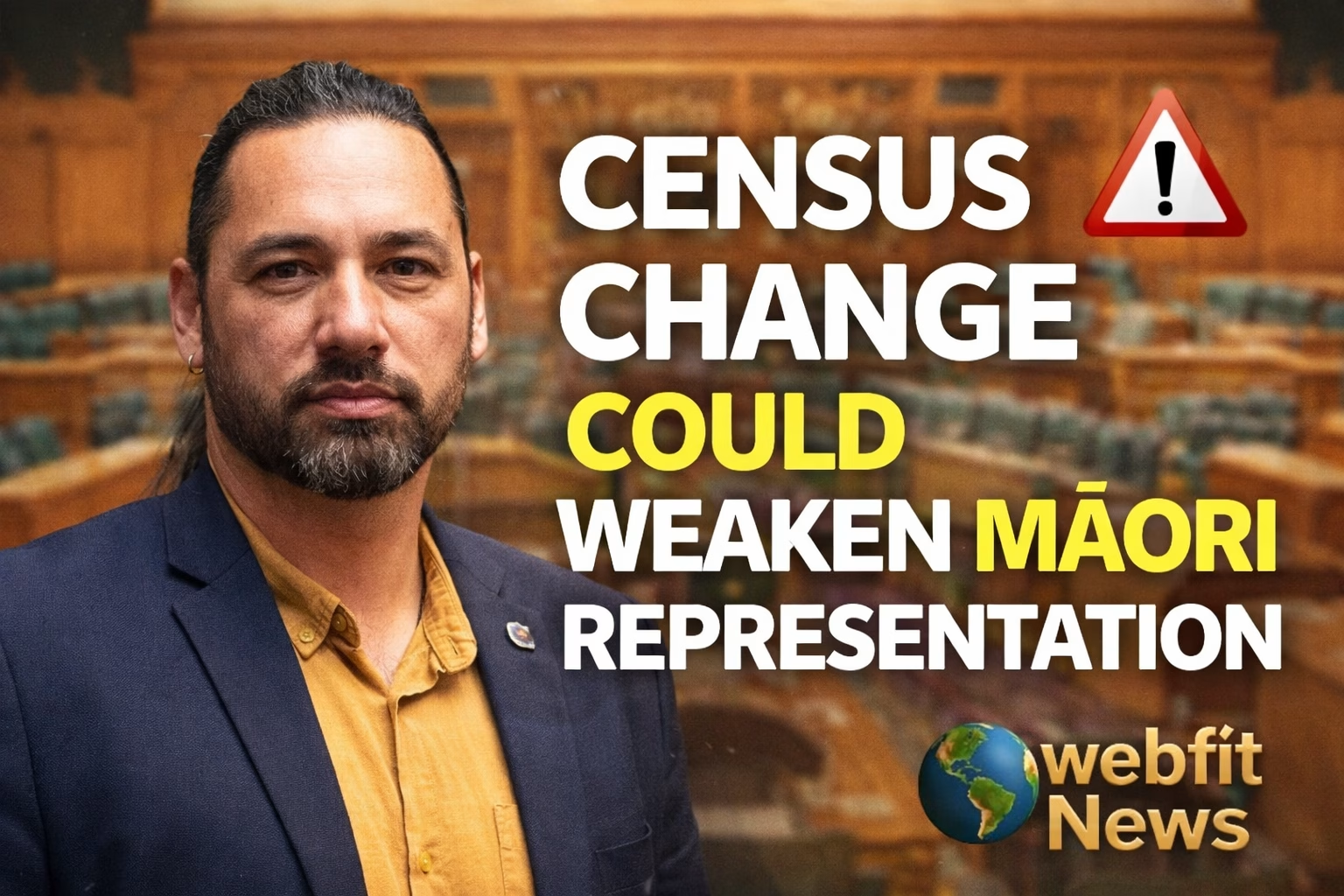
A new government proposal to scrap New Zealand’s traditional five yearly census has sparked concern among Māori leaders and political representatives. Te Tai Tonga MP Tākuta Ferris has warned that replacing the census with government administrative data could lead to the undercounting of Māori communities, potentially affecting political representation and public resource allocation.
The Government introduced legislation this week that proposes ending the long standing census system and moving towards a data model built primarily on information already held across government agencies. If passed, the new system would begin producing official population statistics from 2030.
Ferris argues that the proposal is not simply a technical change in how population statistics are collected. Instead, he believes the shift could significantly impact how Māori populations are measured, funded, and represented across the country.
Concerns About Accuracy of Government Data
According to Ferris, Māori communities are not consistently recorded across many government databases. As a result, relying on those datasets could produce incomplete or inaccurate population counts.
“These changes go far beyond an administrative shift. They undermine the counting of the Māori population, resource allocation, and representation,” Ferris said.
He pointed out that the census has historically been the most reliable method for counting all residents, including those who may not regularly interact with government services.
Ferris added that depending on existing government systems that already have gaps could lead to significant undercounting of Māori populations.
“We know that Māori communities are not consistently captured across government systems. Relying on systems that are fundamentally broken will undercount Māori in favour of larger population groups.”
Potential Impact on Resources and Public Services
Population data plays a critical role in determining how public funding and services are distributed across the country. Government agencies rely heavily on census statistics when deciding how resources such as healthcare funding, education support, housing assistance, and social services are allocated.
Ferris warned that if Māori communities are underrepresented in official data, they may receive less funding and fewer services than they actually require.
“The allocation of resources follows the data. If there is no data to follow, then it will be Māori communities, those with disabilities and takatāpui who continue to miss out,” he said.
Advocates also worry that vulnerable communities who already face barriers to accessing services could be further marginalised if their presence is not properly reflected in national statistics.
Electoral Representation at Stake
Beyond funding, population statistics are also used to determine electoral boundaries and the number of Māori electorates in Parliament.
Ferris stressed that changing the way people are counted could ultimately change how they are represented politically.
“Electoral law uses population data when determining the number and size of Māori electorates. If you change how our people are counted, you change how our people are represented.”
New Zealand currently has several Māori electorates designed to ensure representation for Māori voters. These electorates often cover large geographic areas due to population distribution.
Ferris highlighted the scale of his own electorate, Te Tai Tonga, which spans a vast area including Wellington, the entire South Island, and the Chatham Islands.
The electorate covers approximately 151,727 square kilometres, making it roughly 7,270 times larger than the smallest electorate in the country, Mt Albert.
He argued that the enormous size of Māori electorates already reflects an imbalance in representation.
“When Māori electorates are already stretched across vast geographic areas, any system that risks undercounting Māori only deepens that inequity.”
Māori Data Governance Model Proposed
Ferris also pointed to work already undertaken by Te Kāhui Raraunga and the Data Iwi Leaders Group, which has developed a Māori Data Governance Model designed to improve how Māori data is collected and managed.
The model aims to create a system where Māori and the Crown collaborate to build trustworthy, secure, and culturally appropriate data systems.
Ferris said the Government should consider these frameworks before moving ahead with major changes to the census system.
“Te Kāhui Raraunga has already developed a Māori Data Governance Model that shows how Māori and the Crown can work together to design a safe, secure, and trustworthy system for all New Zealanders,” he said.
He criticised the current proposal for advancing reforms that could affect Māori electoral representation without adequate Māori leadership in the decision making process.
“Ignoring that work and pushing ahead with changes that affect Māori electoral representation without Māori leadership is unacceptable.”
Webfit News Perspective
The proposal to replace New Zealand’s census with government administrative data raises broader questions about data reliability, equity, and democratic representation. Population statistics are not just numbers. They shape funding decisions, infrastructure planning, and the structure of parliamentary representation.
If large communities are undercounted, the consequences can ripple across many areas including public services, political influence, and long-term planning.
As the legislation begins its journey through Parliament, the debate is likely to focus on whether administrative datasets can truly replace the comprehensive reach of the traditional census.
For communities across Aotearoa, the central issue remains simple: how the country counts its people determines how fairly it represents them.
At Webfit News, we will continue monitoring this policy shift closely, as changes to national data systems could influence everything from local council planning to the balance of political representation across New Zealand.