
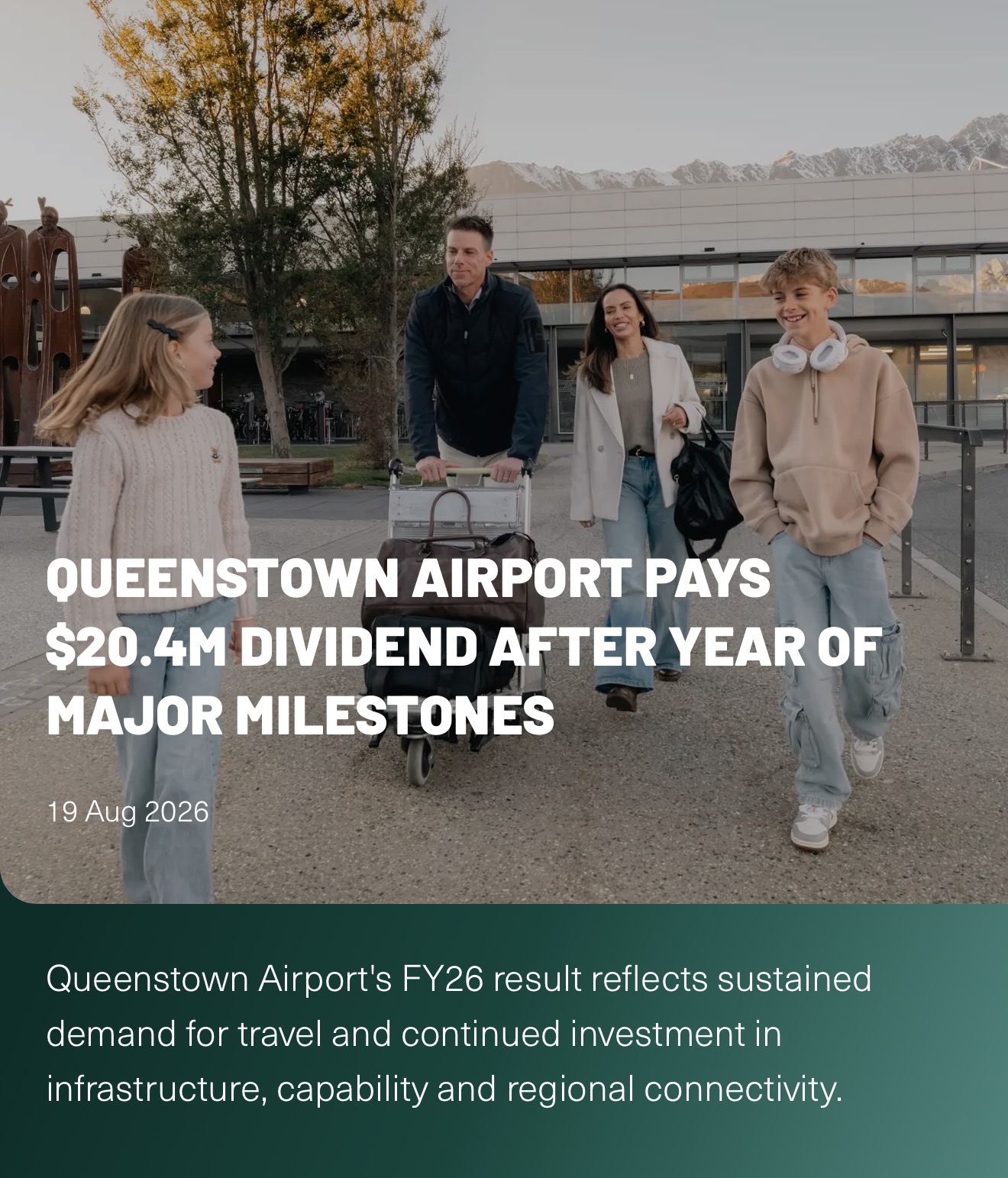
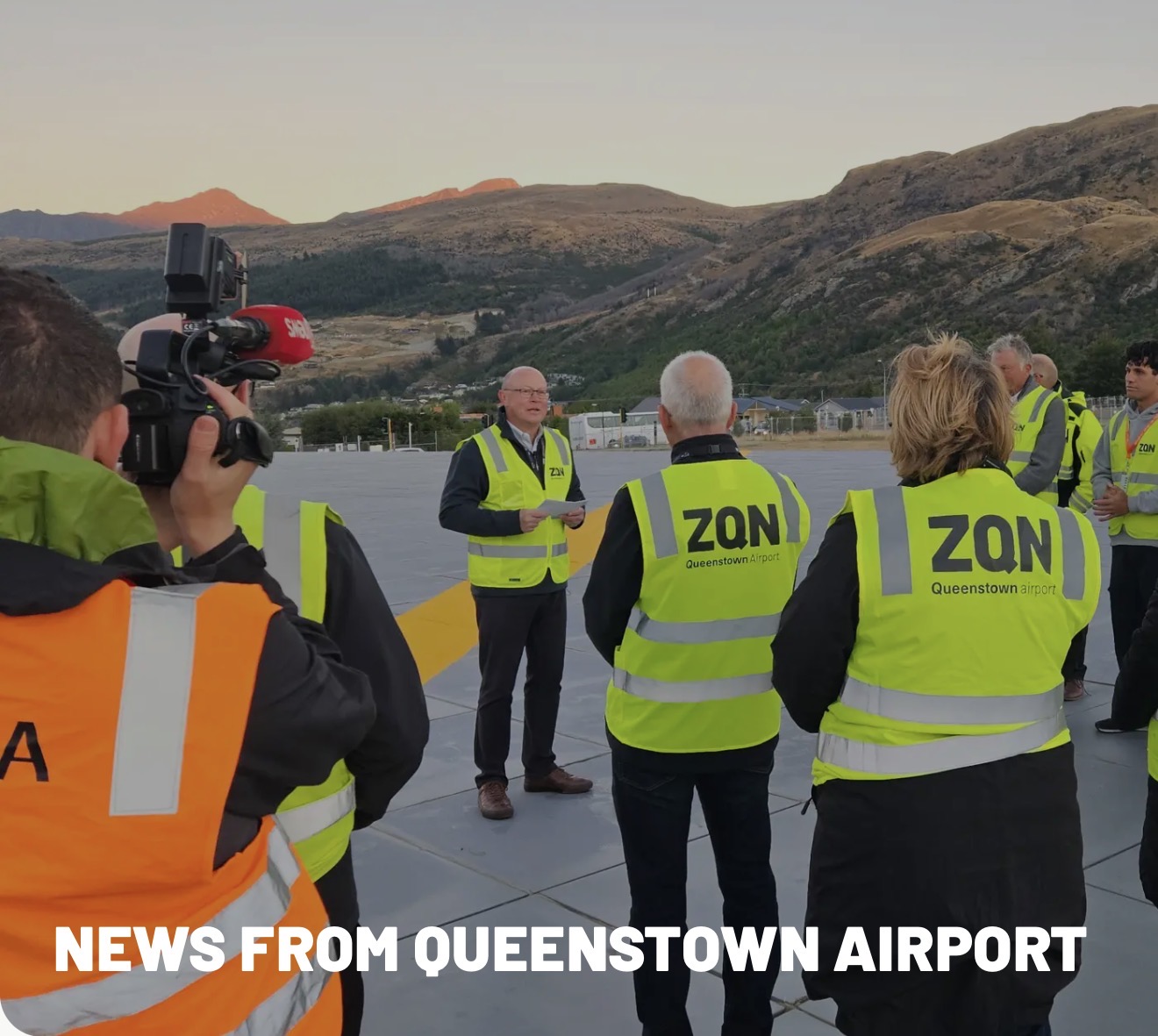
Queenstown Airport Delivers Record $20.4 Million Dividend After Passenger Numbers Hit 2.82 Million
Queenstown Airport has reported one of its strongest years on record, declaring a total dividend of $20.4 million after passenger numbers reached 2.82 million in the year to 30 June 2026.
For local residents, the headline figure is not just about airport profits.
Because Queenstown Lakes District Council is the majority shareholder, $15.3 million of that dividend will go back to the council. Queenstown Airport says that is equivalent to about $470 per ratepayer.
Auckland International Airport, which holds the minority shareholding, will receive the remaining $5.1 million.
The result comes after a year in which Queenstown Airport passed one million international passenger movements for the first time, approved a $65 million airfield upgrade programme and began planning major future expansion.
Queenstown Airport FY26 at a glance
|
Measure |
FY26 result |
Why it matters |
|
Revenue |
$87.1 million |
Shows strong commercial activity |
|
Underlying profit after tax |
$34.0 million |
Reflects core business performance |
|
Reported profit after tax |
$9.1 million |
Lower due to one-off costs and accounting adjustments |
|
Total dividend |
$20.4 million |
Record shareholder return |
|
Council share of dividend |
$15.3 million |
Benefits majority shareholder Queenstown Lakes District Council |
|
Auckland Airport share |
$5.1 million |
Minority shareholder return |
|
Passenger movements |
2.82 million |
Record annual passenger volume |
|
International passenger movements |
More than 1 million |
First time the airport has crossed this milestone |
|
Scheduled aircraft movements |
19,678 |
Indicates the scale of flight activity |
|
Airfield improvement programme |
$65 million |
Major investment in future capacity |
What does the $20.4 million dividend actually mean?
The dividend is the portion of company earnings being returned to shareholders.
Queenstown Lakes District Council receives the largest share because it owns the majority of Queenstown Airport Corporation.
According to the airport, the council’s $15.3 million share is equivalent to about $470 for each ratepayer.
That does not mean individual ratepayers will receive a $470 payment.
Instead, the money goes to the council and can support its overall finances, potentially reducing pressure on other sources of revenue or helping fund services and infrastructure.
The remaining $5.1 million goes to Auckland International Airport.
An interim dividend of $7.22 million was already paid in February, with the balance due to be distributed this month.
Why is underlying profit so much higher than reported profit?
One figure likely to confuse readers is the difference between the airport’s underlying profit and reported profit.
Underlying profit after tax was $34 million.
Reported profit after tax was much lower at $9.1 million.
The airport says the difference was caused by compensation, interest and legal costs linked to a land acquisition, as well as accelerated depreciation.
In simple terms, the underlying result is intended to show how the normal airport business performed, while the reported result includes additional costs and accounting adjustments from the year.
Those costs reduced the final reported profit but did not necessarily indicate weaker passenger demand or poorer day-to-day performance.
Record passenger numbers tell the bigger story
Queenstown Airport handled 2.82 million passenger movements during the financial year.
Passenger movements count arrivals and departures, so one person flying into Queenstown and later leaving would generally count as two movements.
More importantly, international passenger movements exceeded one million for the first time.
Chief Executive Shane O’Hare said the milestone reinforced the importance of Australia to Queenstown and highlighted the airport’s role as an international gateway.
The airport is currently served by Air New Zealand, Qantas, Jetstar and Virgin Australia.
That connectivity is particularly important for Queenstown because tourism remains a major driver of the local economy.
The airport estimates that it influences around $1 billion in economic activity.
That includes spending and business generated through tourism, accommodation, hospitality, transport, employment and wider regional activity.
Why passenger growth matters beyond the airport
An airport handling more passengers can create benefits well outside aviation.
A simple example helps explain it.
If an additional international flight brings 180 visitors into Queenstown, those passengers may spend money on:
- hotels
- restaurants and cafes
- rental cars
- tourism activities
- retail
- ski fields
- local transport
That spending flows through local businesses and supports jobs.
But passenger growth can also create pressure.
More travellers mean greater demand for roads, parking, terminal space, border processing, baggage systems and airport infrastructure.
That is why the next phase of investment is becoming important.
$65 million airfield programme now underway
Queenstown Airport has approved a $65 million programme of airfield improvements.
The work includes construction of a Code C heavy taxiway and a complete overlay of the main runway.
The programme has recently started and is expected to be completed by summer next year.
A taxiway allows aircraft to move between runways, terminals and parking areas without unnecessarily occupying the main runway.
Improving taxiway capacity can make airport operations safer and more efficient, particularly as the number of aircraft movements increases.
The main runway overlay is also significant because airport runways require major maintenance to remain safe under repeated aircraft loads and changing weather conditions.
Terminal expansion is also being planned
The airport is not stopping with the runway.
Concept designs are being developed for a major terminal extension and upgrade.
Architecture firms Warren & Mahoney and Hassell are working on the project.
Queenstown Airport is also preparing to build a new two-storey office building beside Lucas Place.
The building is planned to be Green Star certified and will provide space for airport staff and partner agencies.
That may sound less important than a new runway or terminal, but the airport says its operation is becoming increasingly complex.
More passengers also mean more staff, border processing, airline support, security and operational coordination.
Growth brings a responsibility to get planning right
The airport’s strong result is clearly positive from a financial perspective.
A $20.4 million dividend, record passenger numbers and more than one million international passenger movements show a business with strong demand.
But growth also creates challenges.
Queenstown already faces pressure around housing, transport, infrastructure and tourism capacity.
A busier airport can strengthen the regional economy, but it can also increase traffic, environmental pressure and demand on local services.
That means future airport growth will need to be closely connected with wider district planning.
90 years from rural airfield to international gateway
The financial result also came during Queenstown Airport’s 90th anniversary year.
Chair Simon Flood said the anniversary provided an opportunity to reflect on the airport’s development from a small rural airfield into one of New Zealand’s most important regional gateways.
The airport was also named Large Airport of the Year at the 2025 NZ Airports Awards.
The award recognised operational performance and collaboration across the wider airport community.
What happens next?
Queenstown Airport expects travel demand to remain strong.
Its immediate focus is now on completing the $65 million airfield programme, progressing terminal expansion plans and building the infrastructure required to support future growth.
For residents, the key number this year may be the $15.3 million flowing back to Queenstown Lakes District Council.
But the bigger story is that Queenstown Airport is no longer simply a regional transport facility.
With 2.82 million passenger movements, more than one million international passenger movements and a major investment programme underway, it has become a significant economic asset and a major infrastructure challenge at the same time.
The next test will be whether Queenstown can capture the economic benefits of that growth while managing the pressures that come with it.
References
Queenstown Airport Corporation, FY26 annual financial result and dividend announcement.
Queenstown Airport Corporation, passenger, infrastructure and operational data for the year ended 30 June 2026.
Queenstown Airport Corporation, statements from Chair Simon Flood and Chief Executive Shane O’Hare.