Auckland, New Zealand
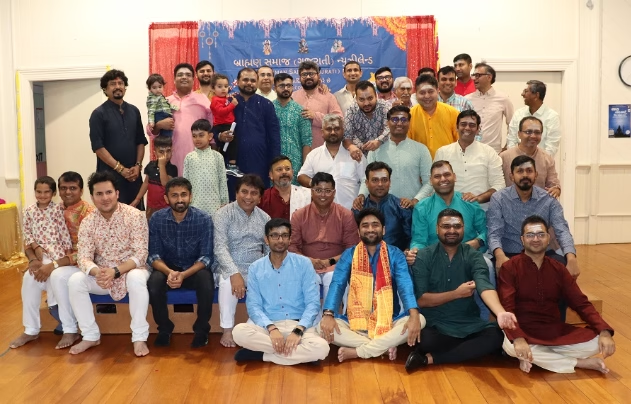
On a calm weekend in Auckland, Balmoral Hall turned into a vibrant centre of culture, learning, and devotion as the Brahmin Samaj (Gujarati) New Zealand organised a grand celebration of Parshuram Jayanti. The event brought together families, community leaders, and young participants in a powerful display of tradition meeting the next generation.
The celebration was not just about rituals. It was about identity, values, and passing knowledge forward in a country thousands of kilometres away from India.
A Festival Beyond Rituals
Parshuram Jayanti marks the birth of Lord Parashurama, considered the sixth incarnation of Lord Vishnu. In Hindu tradition, he represents discipline, knowledge, and justice.
The Auckland event reflected this spirit with a carefully planned programme combining:
- Spiritual teachings
- Youth participation
- Community discussions
- Cultural performances
Families gathered in large numbers, showing how strongly Indian traditions continue to live within New Zealand’s multicultural society.
Children Take the Spotlight
The most powerful moment of the event came from the youngest members of the community.
Children delivered structured presentations on:
- Sapta Rishi (Seven Great Sages)
- Sapta Chiranjeevi (Seven Immortal Beings)
They spoke about figures like:
- Ashwatthama
- Hanuman
- Vibhishan
- Ved Vyasa
- Markandeya
But this was not simple memorisation. The focus was on real-life application.
Young speakers explained how these ancient teachings relate to:
- Discipline in daily life
- Emotional balance
- Respect for knowledge
- Inner strength
That is where this event stood out. It was not about religion alone. It was about practical life values.
Speakers Connect Tradition with Modern Life
The second half of the programme moved into deeper discussions, and this is where things became interesting even for a broader audience.
Binal Nagar
Spoke about how ancient Brahmin values connect with modern leadership and management.
Key takeaway:
Discipline and knowledge management are timeless leadership skills.
Raj Shukla
Focused on emotional balance in life.
He explained that:
- Happiness builds gratitude
- Difficult times build strength
His message was simple but powerful. Life requires balance, not perfection.
Chintanbhai Choksi
Explored the deeper meaning of Sapta Chiranjeevi.
He explained these are not just mythological figures, but symbols of human qualities that remain relevant even today.
Nilay Jani
Spoke about Hanuman ji and the value of selfless service.
His message resonated strongly with the audience:
True strength comes with humility.
Guidance on Unity and Cultural Identity
The event also featured guidance from Maharaj Shri Neerajbhai of Manurewa Shiva Temple.
His focus was clear:
- Cultural preservation
- Community unity
- Collective strength
He highlighted that in a modern, fast-moving world, identity and unity are what hold communities together.
A Moment That Defined the Event
One of the most emotional moments came when children together recited the Hanuman Chalisa.
The hall went silent.
Then filled with voices.
Pure, simple, and powerful.
It was not rehearsed perfection. It was something deeper. A reminder that culture survives when the next generation owns it.
Encouraging the Next Generation
The organisers ensured the event was not just symbolic.
Children were:
- Trained for public speaking
- Guided in understanding scriptures
- Encouraged through awards and certificates
This is important. Because without structured effort, cultural knowledge fades within one generation in diaspora communities
Webfit News Perspective
Events like these are easy to ignore if you only look at them as religious gatherings.
That would be a mistake.
What is happening here is much bigger.
In a country like New Zealand, where diversity is growing rapidly, communities are quietly building bridges between identity and integration.
This event showed three important things:
- Indian culture in New Zealand is not fading. It is evolving.
- The next generation is not disconnected. They are being actively prepared.
- Cultural confidence leads to stronger, more stable communities.
For Kiwi readers, this is a reminder of how multiculturalism works at ground level. Not through policy, but through people.
Conclusion
The Parshuram Jayanti celebration in Auckland was not just a festival.
It was a statement.
A statement that culture, when passed on with purpose, does not weaken with distance. It becomes stronger.
And in today’s world, that matters more than ever.
References
- Source content adapted and verified from Namaskar Gujarat coverage
- Community event details cross-checked with organisers’ programme notes