
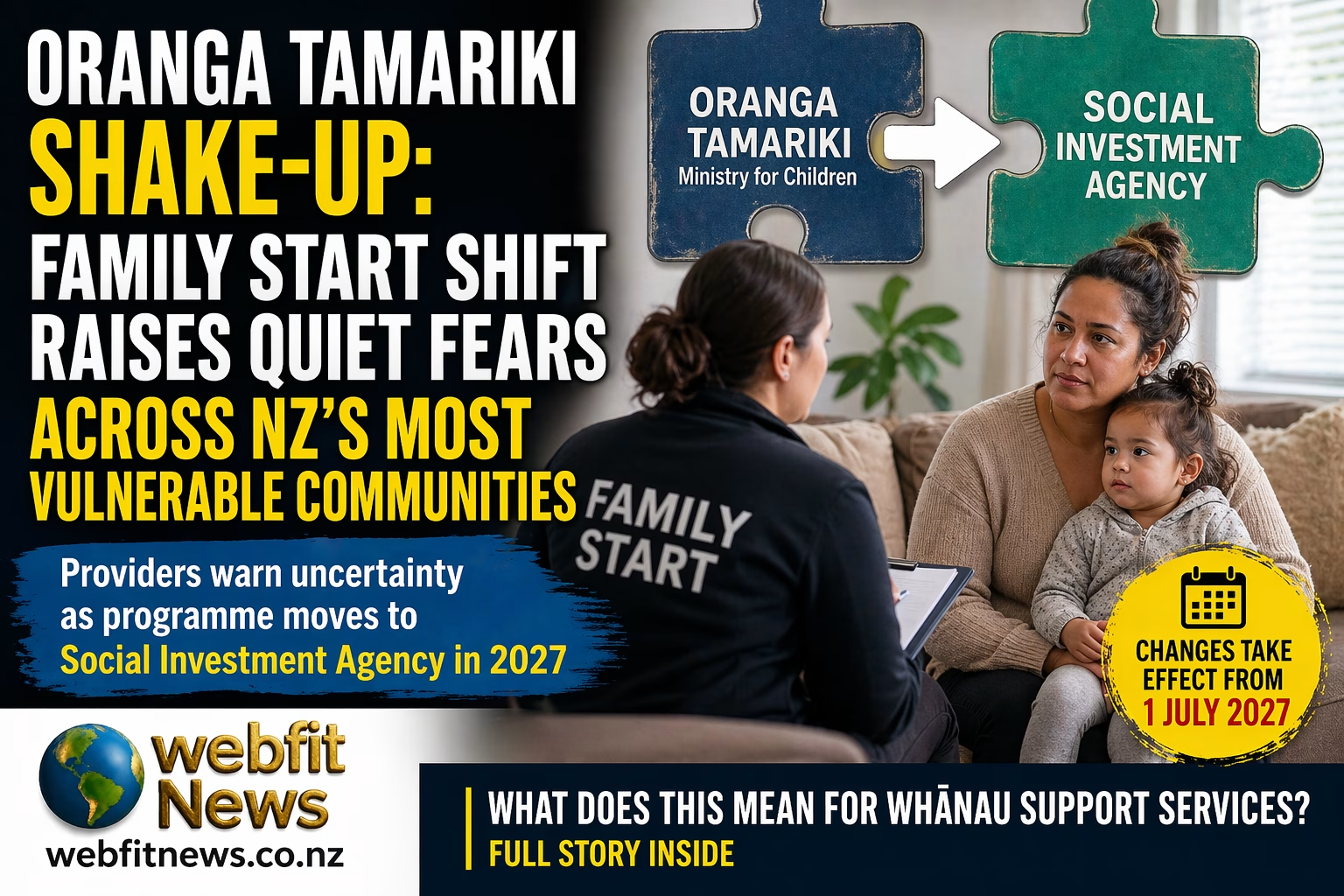
In living rooms across Gisborne, social workers are still doing what they have always done. Sitting with families. Talking through stress, addiction, and parenting struggles and helping quietly before things fall apart.
But behind those front doors, something is shifting.
And the people closest to the work are asking a simple question: what happens next?
WHAT HAPPENED
Trump’s 60-Day War Deadline Approaches as Pressure Builds to End Iran Conflict – WebfitNews
The New Zealand Government is moving the long-running Family Start programme out of Oranga Tamariki and into the Social Investment Agency as part of a wider system review.
The change is scheduled to take effect from 1 July 2027.
Family Start providers, including organisations like Te Runanganui O Ngāti Porou in Gisborne, say they are now facing growing uncertainty. They still do the same work today, but they do not yet know what their contracts, funding models, or operational expectations will look like.
Family Start supports at-risk whānau through early intervention. Workers visit homes and guide parenting, child development, mental health, and addiction support.
The core aim is simple: help families early so children do not end up in crisis systems later.
Now, that entire approach is being repositioned under a new government framework.
BACKGROUND / CONTEXT
This change is not happening in isolation.
It sits inside a broader rethink of how New Zealand delivers social services, especially after years of criticism aimed at Oranga Tamariki. The agency has faced public scrutiny over child removals, cultural failures, and strained relationships with Māori communities.
The Government’s response has been to push toward a “social investment” model.
In plain terms, this means funding decisions will increasingly be driven by data, measurable outcomes, and long-term cost savings rather than traditional service delivery models.
On paper, it sounds efficient. Invest early, measure impact, reduce future harm.
In practice, it introduces a different kind of pressure.
KEY DETAILS / FACTS
- Family Start currently operates under Oranga Tamariki contracts
- The programme focuses on early intervention for vulnerable families
- Services include:
- Parenting support
- Child development advice
- Mental health guidance
- Addiction support
- Transition to Social Investment Agency begins:
- Effective date: 1 July 2027
- Providers say:
- No clear contract details yet
- No clarity on the funding structure
- No confirmed operational changes
WHY THIS MATTERS
This is not just a bureaucratic reshuffle.
It directly affects some of the most vulnerable families in New Zealand.
Family Start operates at a critical point in the system. These are families who are struggling, but not yet in crisis. If support weakens at this stage, the consequences often show up later in more severe ways.
For Māori communities in particular, the stakes are even higher. Many providers are iwi-led or deeply community-rooted. They rely on trust, relationships, and cultural understanding.
If contracts shift toward rigid performance metrics or centralised models, that trust could be disrupted.
For taxpayers, the irony is clear. Early intervention is cheaper than crisis response. If the transition weakens frontline services, long-term costs could increase rather than decrease.
MULTIPLE PERSPECTIVES
Providers on the ground:
Organisations like Te Runanganui O Ngāti Porou are not rejecting change outright. What they are asking for is clarity. Without it, planning becomes difficult, staff retention becomes risky, and service continuity becomes uncertain.
Government view:
The move toward a Social Investment Agency reflects a belief that data-driven decisions will deliver better outcomes. The idea is to fund what works and stop funding what does not.
Policy experts:
Some analysts support the shift, arguing that New Zealand has historically struggled to measure outcomes effectively in social services.
Others warn that over-reliance on metrics can miss the human complexity of family support work.
Public sentiment:
There is no widespread public debate yet. That is part of the issue. Most people do not see Family Start until something goes wrong.
HIDDEN ANGLE (CRITICAL THINKING)
Here is the uncomfortable truth.
This change is not just about improving services. It is about changing how success is defined.
When funding becomes tied to measurable outcomes, providers may feel pressure to prioritise cases that show results quickly. That creates a risk.
The families who need the most help are often the hardest to measure and the slowest to improve.
If the system shifts too far toward data performance, those families could quietly fall through the cracks.
There is also a deeper contradiction.
The Government wants culturally responsive, community-led services. At the same time, it is introducing a centralised, data-heavy funding model.
Those two ideas do not always work together.
WEBFIT NEWS PERSPECTIVE (MANDATORY)
This story is not getting the attention it deserves yet, but it should.
The real test will not be the policy announcement. It will be what happens in the next 12 to 18 months.
Watch for three things:
- Whether providers are included in shaping the new model
- Whether funding remains stable during the transition
- Whether cultural and community-led approaches are protected
If those pieces fall into place, this could strengthen early intervention in New Zealand.
If they do not, the system risks becoming more efficient on paper but weaker where it matters most.
CONCLUSION
Policy changes often look clean from a distance.
But on the ground, they are messy, human, and unpredictable.
Family Start has never been about systems. It has always been about people showing up early, before things break.
The question now is simple.
Will this reform strengthen that work, or quietly weaken it while aiming to optimise it?
New Zealand will find out, but probably not immediately.
The real impact will show up years later, in the lives of children who either got help in time or did not.