Winston Peters Wants BNZ Back. But Can New Zealand Actually Afford It?
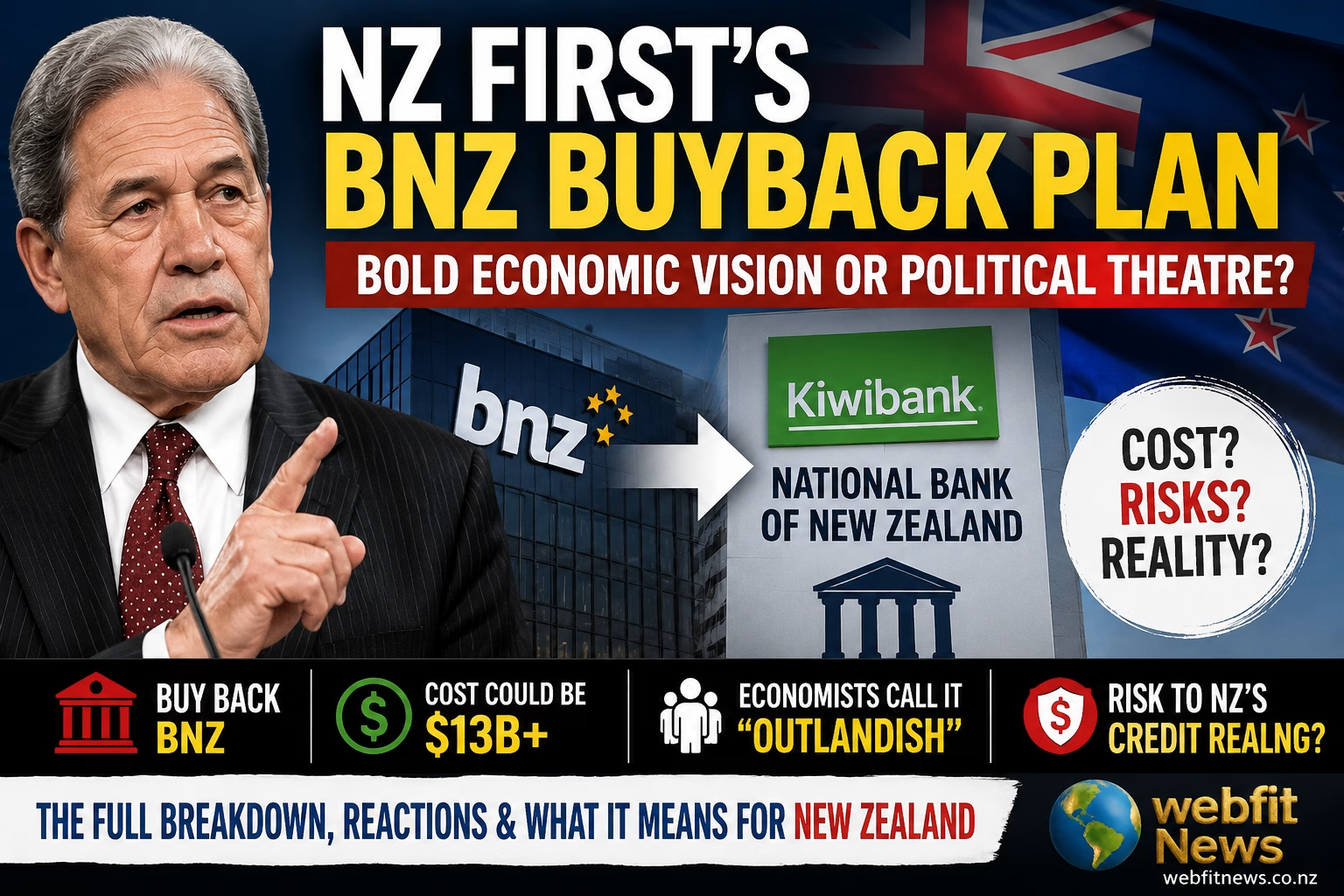
New Zealand First has thrown one of the boldest economic ideas of the 2026 election cycle onto the table: buy back the Bank of New Zealand from Australia’s NAB, merge it with Kiwibank, and create a fully Crown-owned “National Bank of New Zealand.”
Supporters say it is about economic sovereignty, local control, and finally challenging the dominance of Australia’s banking giants.
Critics say it is fantasy economics.
And somewhere in between sits a deeper public frustration many New Zealanders quietly agree with: why are billions in banking profits leaving the country every year while households struggle with rising mortgage rates, bank fees, and cost-of-living pressure?
The proposal has instantly become one of the most talked-about political ideas of the year.
But is this serious policy or simply campaign-stage political theatre?
From Girmit to Global Identity: Why the 147th Anniversary Matters Far Beyond Fiji – WebfitNews
What NZ First Is Actually Proposing
At a campaign event in West Auckland on 17 May 2026, NZ First leader Winston Peters unveiled two major financial policies:
- A compulsory KiwiSaver scheme from birth with a $1,000 government contribution for newborns
- A plan to buy back Bank of New Zealand from Australian owner National Australia Bank
The party says BNZ would then merge with Kiwibank to form a new fully state-owned “National Bank of New Zealand.”
According to NZ First, the goal is simple:
- Reduce foreign control over the banking sector
- Increase competition
- Keep profits inside New Zealand
- Support long-term lending for infrastructure, agriculture, and small businesses
NZ First argues the current system is too heavily dominated by Australian-owned banks.
Today, ANZ, ASB, BNZ and Westpac collectively control around 85% of New Zealand’s banking market.
The party claims billions of dollars leave New Zealand annually through bank profits flowing offshore.
Winston Peters framed the proposal not as “nationalisation” but as “taking back our country.”
Why The Idea Resonates With Some Voters
This is where the proposal becomes politically interesting.
Even many people who do not support NZ First may still feel uneasy about how concentrated New Zealand’s banking system has become.
Over recent years:
- Bank profits have surged
- Mortgage holders have faced higher interest rates
- Small businesses have complained about access to affordable lending
- Rural sectors have increasingly criticised lending restrictions
The Commerce Commission’s banking market study in 2024 concluded the sector was structurally uncompetitive.
That finding gave political oxygen to parties looking for stronger intervention.
NZ First is attempting to tap directly into that frustration.
The argument is emotionally powerful:
“If taxpayers rescued BNZ in the past, why should Australians own it now?”
That line will likely resonate strongly with some older voters who remember BNZ’s history before privatisation.
The Biggest Problem: BNZ Is Not For Sale
Here is the issue critics immediately raised.
BNZ is not sitting on Trade Me waiting for offers.
It is fully owned by NAB, one of Australia’s biggest banking groups.
Finance Minister Nicola Willis called the proposal “extremely reckless” and questioned how taxpayers could possibly afford it without major borrowing or tax increases.
Prime Minister Christopher Luxon reportedly dismissed the plan as unrealistic and joked it sounded more like Green Party economics than coalition policy.
ACT leader David Seymour went further, suggesting the proposal sounded dangerously close to forced nationalisation.
That concern matters.
Because unless NAB voluntarily agrees to sell, the government would either:
- Need to offer a massive premium price
- Or legislate compulsory acquisition powers
Both options would be politically explosive.
The Price Tag Nobody Can Agree On
This is where the economics become murky.
NZ First has floated a figure above NZ$7.5 billion.
Most analysts say that number is nowhere near realistic.
Professor Claire Matthews from Massey University noted BNZ’s book value alone sits around NZ$13.7 billion.
A negotiated market sale could potentially cost much more.
Some estimates suggest the final price could push toward NZ$15 billion or beyond once acquisition premiums are added.
That creates a serious question:
Can New Zealand realistically borrow that much for a bank purchase during a period of already rising government debt pressure?
Supporters argue BNZ’s estimated NZ$1.5 billion annual profits could eventually service the debt.
Critics counter that large-scale sovereign borrowing could:
- Push up interest rates
- Increase fiscal pressure
- Trigger concerns from credit rating agencies
- Reduce investor confidence
The Taxpayers’ Union warned the proposal could hurt New Zealand’s international credit standing at a time global markets are already cautious.
The Historical Irony
One uncomfortable truth complicates the entire debate.
New Zealand taxpayers already rescued BNZ once before.
In 1990, the government injected around NZ$620 million into the bank to prevent collapse.
Just two years later, the National government sold BNZ to NAB for NZ$1.48 billion.
Supporters of the buyback say New Zealand sold a strategic national asset too cheaply.
Critics say history proves exactly why governments should stay out of banking.
Former finance minister Ruth Richardson described the proposal as a “bankruptcy of thinking,” warning state-owned banks historically expose taxpayers to enormous financial risks.
That historical divide sits at the centre of the debate.
Could A State-Owned Mega Bank Actually Work?
Interestingly, NZ First is not entirely wrong when it points to international examples.
Countries like:
- Singapore
- Canada
- Norway
- France
all operate major state-backed or government-linked banking institutions alongside private sector banks.
The real question is not whether state-backed banks can exist.
The real question is whether New Zealand has the scale, governance discipline, and political stability to run one effectively without turning it into a political football.
That concern is not theoretical.
Critics fear future governments could pressure a state-owned mega bank into politically motivated lending decisions.
Supporters argue the same could be said about many strategic public assets already owned by the Crown.
The Real Political Strategy Behind The Proposal
This is where the conversation becomes more strategic than economic.
Even if the proposal never happens, NZ First may still achieve exactly what it wants politically.
The policy allows Winston Peters to position himself as:
- Anti-big-bank
- Anti-foreign-control
- Pro-economic sovereignty
- Pro-New Zealand ownership
Those themes historically play well with portions of the electorate, especially during periods of economic stress.
The proposal also forces National and Labour into uncomfortable territory.
If they reject the idea entirely, NZ First can accuse them of protecting foreign banking interests.
If they engage seriously, the political conversation shifts toward deeper scrutiny of the banking sector.
Either way, Peters controls the narrative.
That alone may make the proposal politically successful, even if economically impossible.
Webfit News Perspective
The BNZ buyback proposal reveals something bigger than just banking policy.
It exposes a growing public mood in New Zealand around ownership, control, and economic identity.
Many New Zealanders increasingly feel large parts of the economy are controlled elsewhere while ordinary people carry the pressure at home.
NZ First understands that frustration and is packaging it into a headline-grabbing proposal designed to cut through election noise.
But there is also a serious credibility gap.
Right now, the policy raises more questions than answers:
- How exactly would the acquisition happen?
- What would the final cost be?
- Would taxpayers carry the risk?
- Could New Zealand’s credit rating be damaged?
- Would the banking system become more stable or more political?
Without detailed financial modelling, legal pathways, and Treasury-backed analysis, the proposal remains more emotional than operational.
That does not mean the public conversation around banking competition is invalid.
In fact, the Commerce Commission findings suggest the debate is overdue.
But transforming that frustration into workable economic policy is far harder than delivering a campaign speech.
Conclusion
NZ First’s BNZ buyback proposal is politically clever, emotionally powerful, and economically controversial.
Supporters see economic patriotism.
Critics see fiscal recklessness.
Most economists currently see a proposal that is dramatically undercooked.
The idea may never become reality.
But it has already succeeded in doing one thing:
forcing New Zealanders to ask who really controls the country’s banking system, and whether the current model is genuinely working for ordinary people.
That question will not disappear anytime soon.
References
- NZ First official policy announcements
- RNZ political coverage
- NZ Herald political and banking analysis
- Commerce Commission banking market study 2024
- Public commentary from Nicola Willis, David Seymour, and Ruth Richardson
- Massey University banking analysis
- Historical BNZ privatisation records
- Reserve Bank and Treasury public banking data