
By WebFit News Desk | January 2026
New census and income data from multiple advanced economies point to a striking and consistent pattern.
Across Australia, the United States, the United Kingdom, and parts of Europe, people born in India are among the highest earners of any major migrant group, often outperforming both native-born populations and other overseas-born communities.
This is not a one-country anomaly. It is a global trend backed by official statistics.
Australia: India-Born Residents Top the Income Table
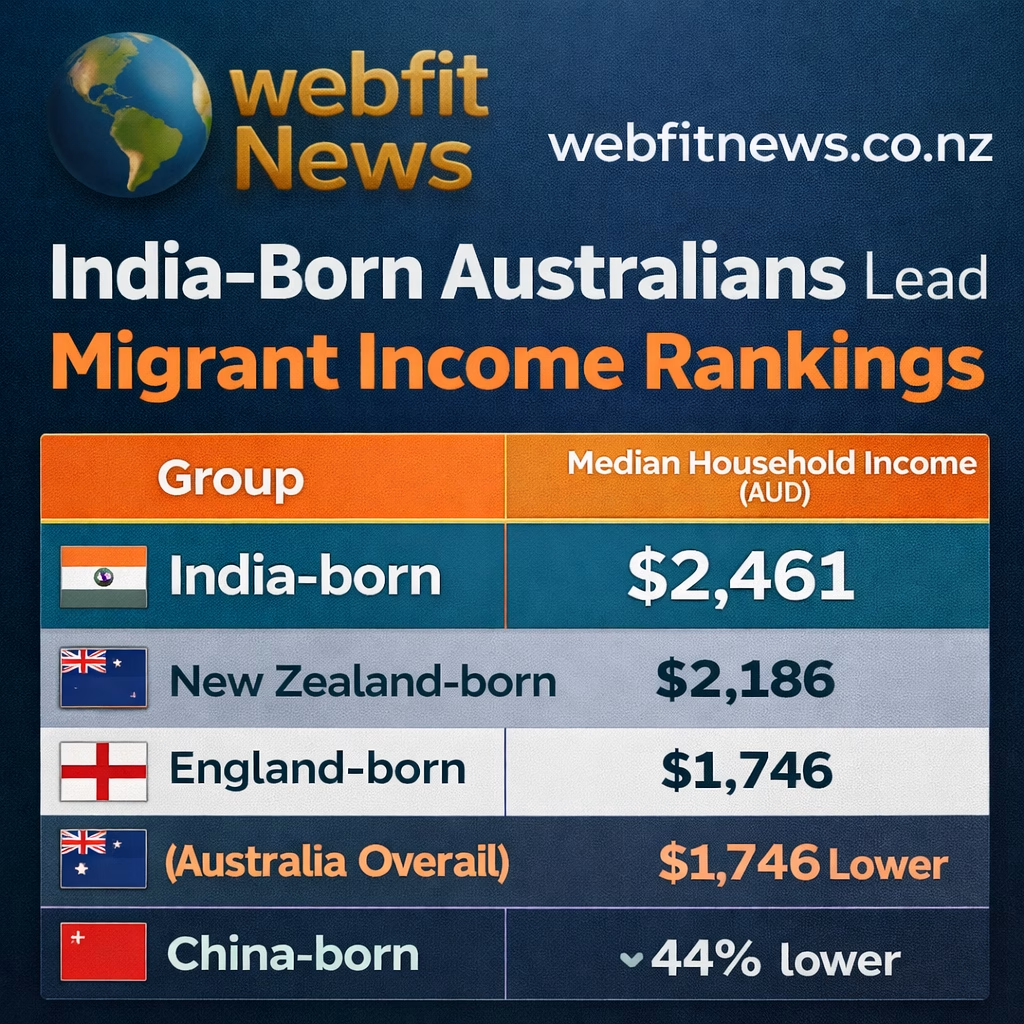
According to the Australian Bureau of Statistics 2021 Census, India-born Australians now sit at the top of the income scale among major migrant groups.
Median incomes in Australia (weekly):
| Group | Personal Income | Family Income | Household Income |
|---|---|---|---|
| India-born | ~$1,015 | ~$2,409 | ~$2,461 |
| New Zealand-born | Lower | Lower | ~$2,186 |
| England-born | Lower | Lower | Lower |
| Australia-born (national median) | Lower | Lower | ~$1,746 |
| China-born | ~40% lower | ~44% lower |
In plain terms, India-born households earn significantly more than the national average and more than other large migrant communities.
This includes both permanent and temporary residents classified as usual residents by the ABS.
United States: Small Population, Outsized Contribution
The same pattern appears even more clearly in the United States.
According to Pew Research Centre analysis of U.S. Census data:
- Indian Americans make up about 1.5% of the U.S. population
- Median household income (2023): ~$151,200
- U.S. national median household income: ~$75,000
- Median for Asian Americans overall: ~$112,000
Because of these earnings, Indian-headed households contribute an estimated 5 to 6% of total U.S. income tax revenue, far exceeding their population share.
This is a rare case where a small demographic group carries a disproportionately large economic weight.
Europe Tells the Same Story
The trend is not limited to English-speaking countries.
Germany
- Indian nationals working full-time earn among the highest median gross monthly wages
- Estimated median: ~€5,400
- Higher than German nationals and most other migrant groups
United Kingdom
- Indian households rank among the highest earners by ethnicity
- Median household incomes are consistently above the national median
- Well ahead of most other minority groups
What Explains the Pattern?
Data across countries points to a combination of factors, rather than a single cause.
Key contributors include:
- High levels of education
- Concentration in skilled professions such as technology, medicine, engineering, and finance
- Strong participation in formal labour markets
- High rates of entrepreneurship and professional employment
- Cultural emphasis on education, merit, and long-term mobility
These factors translate into higher productivity, higher wages, and stronger tax contributions in host economies.
A Broader Economic Impact
High earnings do not only benefit individuals. They flow through the wider economy.
Examples include:
- Higher income tax contributions
- Increased consumer spending
- Business formation and job creation
- Strong participation in professional and civic institutions
This is why economists often focus not just on migrant numbers, but on economic composition.
A Global Pattern, Not an Exception
When the same outcome appears across Australia, the U.S., Germany, and the UK, it stops being coincidence.
Across advanced economies, Indian-born and Indian-origin communities consistently:
- Earn more than national medians
- Contribute more in taxes relative to population size
- Integrate strongly into skilled labour markets
This does not mean every migrant succeeds, nor does it dismiss challenges faced by individuals.
But at a population level, the data is clear.
Why This Matters
Public debates around migration often rely on assumptions, emotion, or incomplete data.
Income, productivity, and tax contribution are measurable.
And on those measures, Indian-origin communities rank among the strongest contributors in the developed world.
That is not a political statement.
It is a statistical one.
WebFit News
Independent reporting. Evidence over noise.