Introduction
By early 2026, New Zealand has become one of the most digitally connected societies in the world. Smartphones, social platforms, and algorithm-driven feeds are now woven into everyday life. From work and education to social connection and entertainment, screens sit at the centre of modern living.
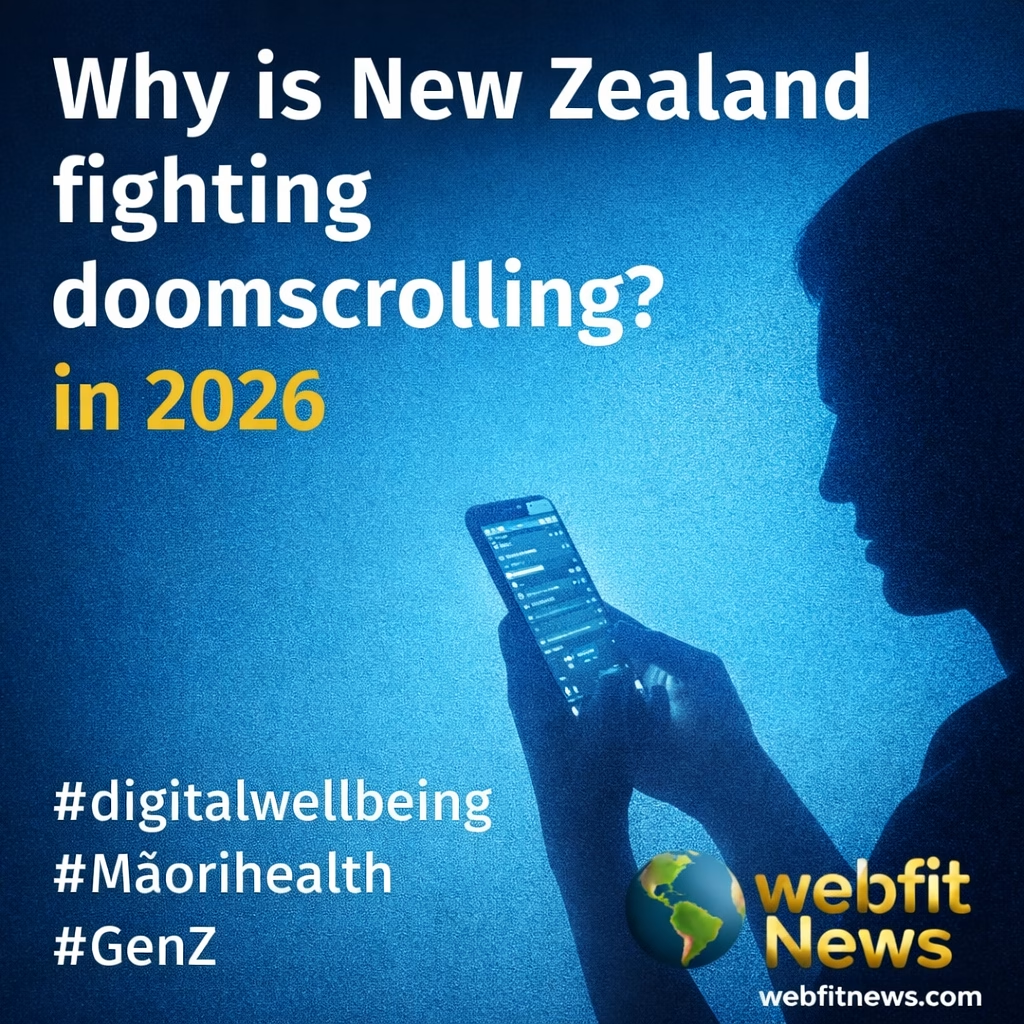
But alongside record connectivity, a growing number of New Zealanders are asking a harder question. Is constant connection improving our lives, or quietly draining our attention, health, and sense of presence?
A new digital wellbeing movement is emerging across Aotearoa. It spans researchers, Māori health practitioners, educators, and a surprising new group of online creators who are using social media to tell people to stop scrolling.
A Hyper-Connected Nation Feeling the Strain
New Zealand now has mobile connections exceeding its population, driven by multi-device use and eSIM adoption. More than 96 percent of people rely on digital tools for daily participation in society. Social media alone reaches over four million users nationwide.
On paper, average daily usage of just over two hours may not appear extreme. The concern lies in how that time is spent. Short-form video platforms, particularly TikTok and Instagram Reels, rely on infinite scroll design. There is no natural stopping point. Content flows continuously, pulling users from one clip to the next.
Researchers warn that this design disrupts the brain’s ability to self-regulate. The normal cue that signals task completion disappears. Users often stay longer than intended, not because they choose to, but because the system is built to keep them there.
What the Infinite Scroll Does to the Brain
The infinite scroll is not accidental. It is engineered to maximise attention. Psychologists compare its effect to variable reward systems found in gambling. Each swipe promises novelty. The brain keeps searching for the next hit.
Studies from New Zealand universities show that this behaviour often bypasses conscious decision-making. Even people with strong self-control report difficulty stopping once the scroll begins. Over time, this leads to what researchers describe as cognitive capture, where intention gives way to automation.
For heavy users, the impact shows up in familiar ways:
- Poor sleep from late-night screen use
- Heightened anxiety linked to constant notifications
- Social comparison that lowers mood and confidence
- Reduced ability to focus on long tasks
While the link between screen time and mental health is complex, experts agree that a smaller group of problematic users experiences significant harm.
The Rise of Anti-Doomscroll Influencers
One of the most unexpected responses to this problem is coming from within social media itself.
A new category of creators, often called disruption influencers, is gaining traction. Instead of chasing watch time, they interrupt it. Their videos are designed to break the trance.
One of the most visible figures is Olivia Yokubonis, known online as Olivia Unplugged. Her videos are calm, direct, and deliberately unspectacular. She often asks viewers a simple question. Can you remember what you were watching before this?
For many, the answer is no.
Her message is not moralistic. It is permission-based. You can stop. You can put the phone down. You can come back later.
The paradox is intentional. To reach people trapped in algorithmic loops, she meets them where they already are.
Making the System Visible
Another prominent voice is Cat Goetze, also known as CatGPT. A former tech insider, she focuses less on personal behaviour and more on system design.
Her core argument is blunt. Users are not weak. They are outmatched.
She explains how teams of engineers optimise platforms for engagement, not wellbeing. By making the mechanics visible, she removes shame and reframes the issue as structural, not personal.
Her company, Physical Phones, takes the idea further by offering Bluetooth-enabled landline devices. Users can stay reachable without opening the smartphone gateway to distraction. Her message has struck a chord. Offline is becoming a form of status.
A Māori Framework for Digital Health
In Aotearoa, digital wellbeing discussions are increasingly shaped by Māori health models.
Sir Mason Durie’s Te Whare Tapa Whā framework views wellbeing as a four-walled house:
- Taha Tinana, physical health
- Taha Hinengaro, mental and emotional health
- Taha Whānau, social and family wellbeing
- Taha Wairua, spiritual connection and meaning
Health practitioners are now applying this model to digital life. Excessive screen use weakens multiple walls at once. Sleep disruption affects the body. Social media anxiety strains the mind. Phone use during conversations erodes whānau connection. Constant stimulation pulls attention away from whenua and presence.
When one wall weakens, the whole structure becomes unstable.
For many Māori youth, reconnecting with nature is seen as the most effective counterbalance to digital overload. Stepping away from screens is not avoidance. It is restoration.
Can Technology Fix the Problem It Created?
Not everyone believes disconnection is realistic. Instead, a growing sector is focused on using technology to manage technology.
One example is Focus Friend, a gamified productivity app that became popular among New Zealand students in late 2025. It uses an animated character that thrives when the user stays focused and struggles when they open blocked apps.
The appeal lies in gentle accountability rather than strict restriction. Behavioural experts say these low-pressure nudges often work better than hard bans, which users can easily bypass.
The goal is not digital abstinence. It is conscious use.
Online Harm Remains a Serious Issue
While wellbeing tools are growing, online harm continues to rise. Reports under the Harmful Digital Communications Act have reached record levels. Youth-focused platforms show a disproportionate share of harmful content, including bullying and harassment.
This has prompted a government inquiry into algorithmic risk, particularly around youth exposure to harmful material and targeted advertising.
Experts warn that digital harm does not affect all groups equally. Māori and Pacific communities experience higher exposure and fewer support resources, deepening existing inequities.
When Disconnection Becomes a Luxury
A final tension sits beneath the entire movement. Digital detox is becoming an industry.
High-end retreats in Wanaka and Queenstown now market device-free living as a premium experience. For those who can afford it, rest is curated, quiet, and guaranteed.
For many others, constant connection is not optional. Gig workers, caregivers, and migrants rely on devices for income and community. This raises an uncomfortable question. Is wellbeing becoming something only the wealthy can buy?
Conclusion
New Zealand’s relationship with technology is shifting. The era of blind adoption is ending. In its place is a more mature conversation about attention, health, and agency.
From Māori health frameworks to disruption influencers and focus-first tools, Aotearoa is experimenting with ways to reclaim control from the infinite scroll.
The challenge ahead is collective. Digital wellbeing cannot rest solely on individual willpower. It requires cultural change, smarter design, and public acknowledgement that attention is a finite resource.
The real rebellion of 2026 may not be deleting apps. It may simply be choosing, consciously, where our minds are allowed to rest.