A quiet workplace, a hidden story
Behind the calm setting of a Christchurch massage business, something far more troubling was unfolding.
For years, vulnerable migrant workers showed up, worked long hours, and went home underpaid, unheard, and unsure of their rights. Now, that silence has been broken.
A major ruling by the Employment Relations Authority has brought the issue into the spotlight, raising serious questions about how such exploitation continues to happen in New Zealand.
What Happened
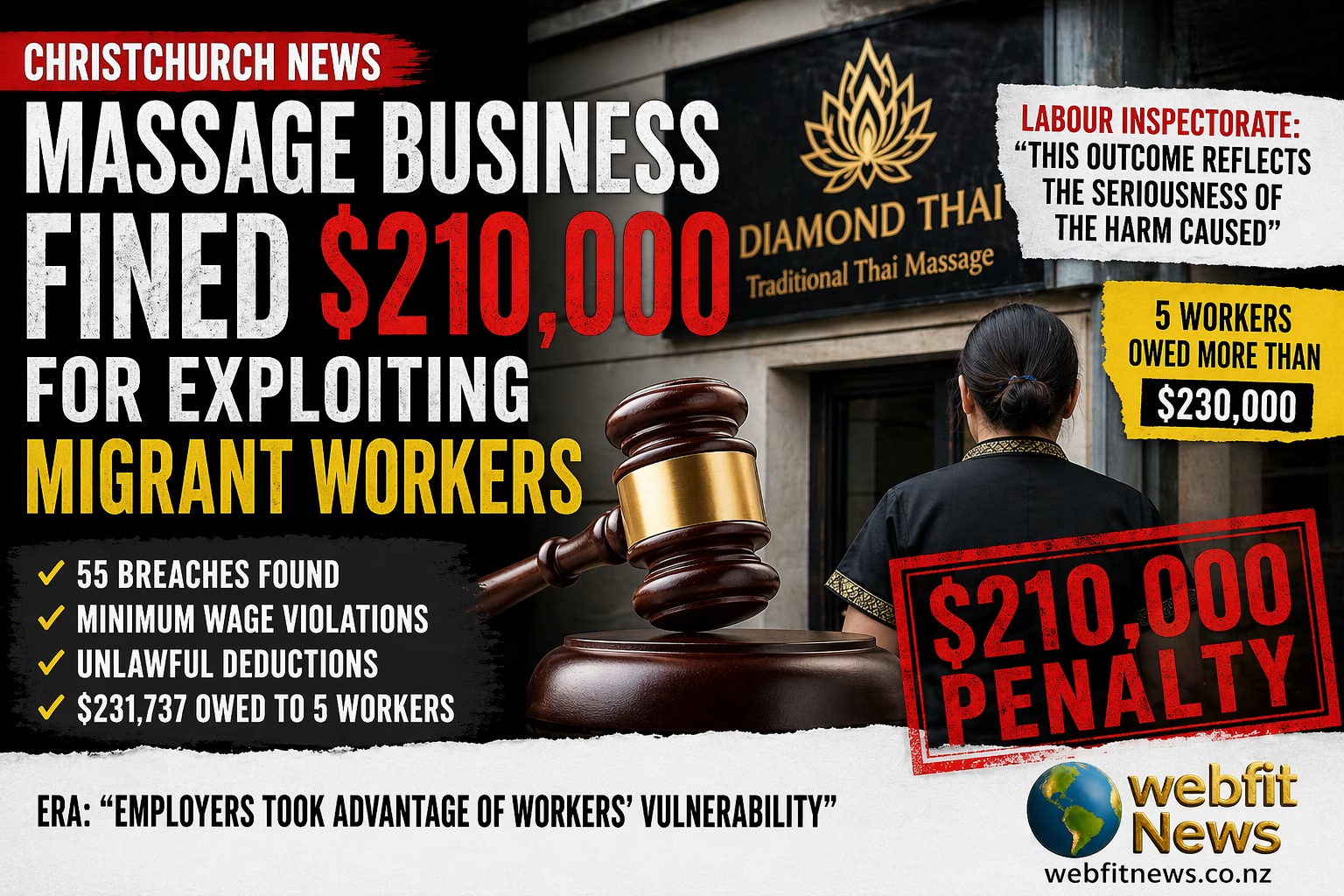
A Christchurch-based massage business, Mother’s Thai trading as Diamond Thai, along with its sole director Janya Duangjai, has been ordered to pay $210,000 in penalties.
This comes after a detailed investigation by the Labour Inspectorate uncovered widespread breaches of employment law between November 2020 and 2023.
On top of this penalty, the business had already agreed to pay more than $230,000 in arrears to five affected workers.
The ruling confirms that multiple employment standards were violated, and that the workers were denied fair wages and basic entitlements over a sustained period.
Background: A Pattern, Not an Exception
This case is not isolated.
New Zealand has been grappling with migrant worker exploitation across industries including hospitality, construction, horticulture, and personal services.
Migrant workers often face:
- Language barriers
- Limited knowledge of employment rights
- Dependence on employers for visas
- Fear of losing their job or immigration status
These factors create an environment where exploitation can go unnoticed for years.
Investigations like this one typically take time, partly because workers hesitate to speak up.
Key Details and Findings
The Employment Relations Authority identified 55 separate breaches of employment standards.
Major violations included:
- Failure to pay minimum wage for all hours worked
- Unlawful deductions from wages
- Charging workers premiums for employment
- No proper employment agreements
- Incorrect public holiday and sick leave payments
- Poor or missing wage and time records
Penalty Breakdown:
- $140,000 penalty for the business
- $70,000 penalty for the director
- $21,000 allocated to each of the five workers
The Authority also confirmed that workers were owed $231,737 in unpaid wages.
Despite this, there is no clear evidence that all payments have been made, and the business is no longer operating.
Why This Matters in New Zealand
This case cuts deeper than just one business.
It highlights a structural problem that affects:
- Migrant communities
- Small business regulation
- Labour market fairness
- New Zealand’s international reputation
New Zealand promotes itself as a fair and safe place to work. Cases like this directly challenge that image.
There is also a ripple effect. When exploitation goes unchecked:
- Honest businesses are undercut
- Workers lose trust in the system
- Enforcement agencies face credibility pressure
Multiple Perspectives
Government and Enforcement
Labour Inspectorate’s Migrant Exploitation Manager Natalie Gardiner called the case “egregious” and welcomed the heavy penalties.
Her message was clear:
Employers who break the law should expect serious consequences.
She also pointed out that directors can be held personally accountable, even if business structures change.
Legal View
ERA Member Peter van Keulen noted that many breaches appeared deliberate, even if partly based on incorrect understanding of employment rules.
This is a critical point.
It suggests that ignorance is often used as a shield, but the law does not accept it as an excuse.
Worker Reality
The most important perspective is often the least heard.
These workers:
- Had limited support
- Lacked awareness of their rights
- Felt unsafe raising concerns
This is exactly the kind of vulnerability that exploitation feeds on.
Hidden Angle: The System Still Reacts, Not Prevents
Here is the uncomfortable truth.
New Zealand is good at reacting to exploitation after it happens. It is not as effective at preventing it early.
Think about this:
- The breaches continued for nearly three years
- Workers were underpaid over long periods
- Enforcement only came after significant harm was done
Why?
Because the system relies heavily on complaints.
And vulnerable workers rarely complain.
There is also a gap in proactive auditing, especially in small businesses where oversight is limited.
This is where the real problem sits.
Webfit News Perspective
This case should not be seen as a one-off enforcement success. It should be treated as a warning signal.
If five workers in one business can be underpaid over $230,000, how many similar cases are still hidden?
The next phase for New Zealand must shift from punishment to prevention.
That means:
- More proactive inspections
- Better migrant education on rights
- Stronger accountability for directors
- Faster response systems
For the community, the takeaway is simple.
If something feels wrong at work, it probably is.
And for businesses, the message is even clearer.
Compliance is not optional. It is the baseline.
Conclusion
The $210,000 penalty sends a strong message, but it also raises bigger questions.
How did this go on for so long?
Why were workers left unprotected?
And how many more cases are still under the surface?
New Zealand has the laws in place.
What it needs now is stronger execution, earlier intervention, and a system that protects workers before the damage is done.
Credit: Ministry of Business, Innovation and Employment (MBIE) Media Release