
ADELAIDE, 28 July 2026
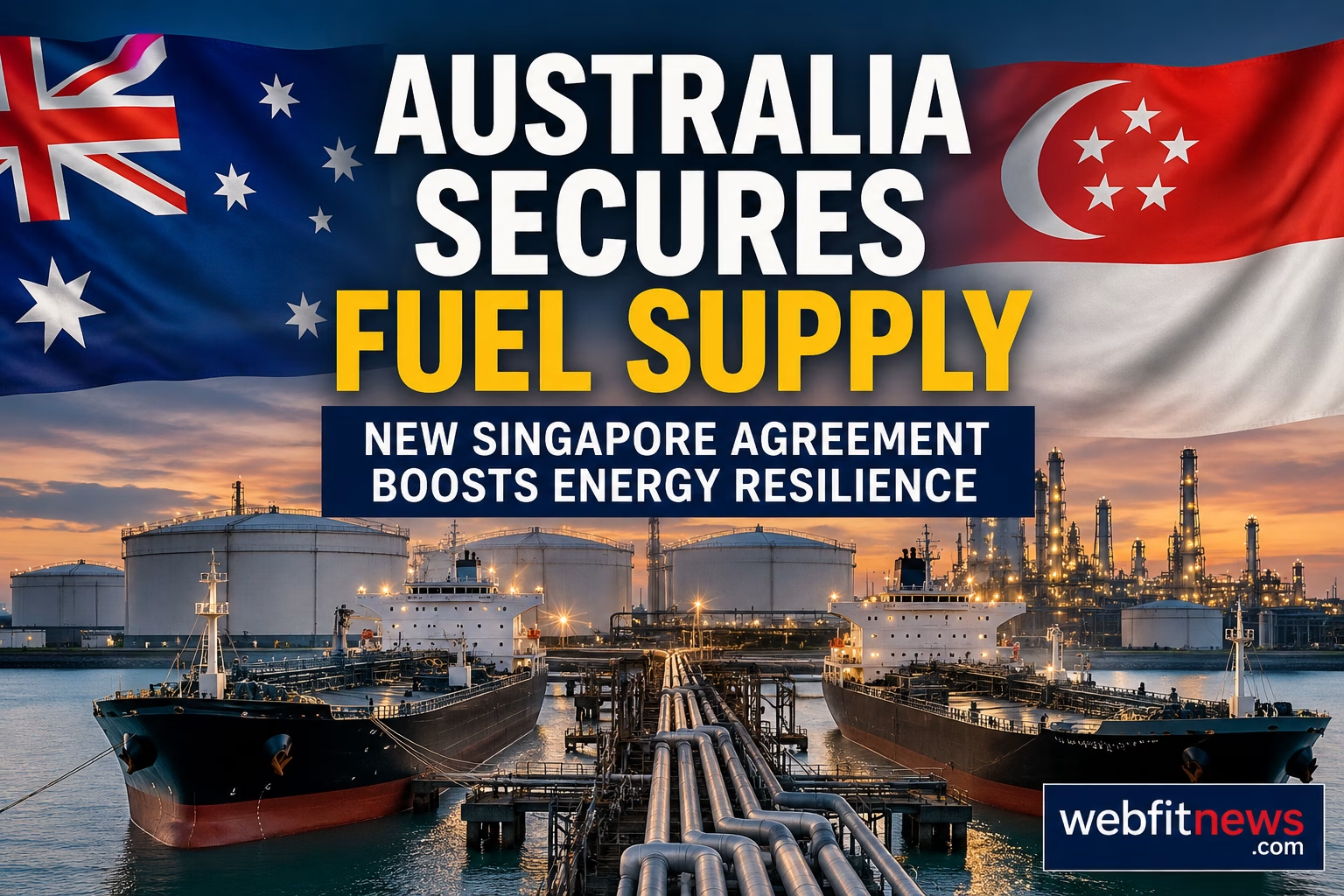
Australia is strengthening its fuel security through a new economic resilience agreement with Singapore while also pursuing greater domestic refining capacity, Foreign Minister Penny Wong says.
Speaking to FiveAA Breakfast in Adelaide, Wong said the new Protocol on Economic Resilience and Essential Supplies would give Australia and Singapore priority access to important goods during periods of international disruption.
The arrangement covers fuel and other essential supplies, including food, and is intended to reduce the risk of shortages when conflict, trade restrictions or other global events interrupt normal supply chains.
Wong said the agreement formed part of the Australian Government’s wider efforts to secure the diesel, petrol, aviation fuel and fertiliser needed by households, businesses, farmers and transport operators.
The Foreign Minister also addressed Australia’s limited refinery capacity, Labor’s position on Hamas and Gaza, and questions surrounding political fundraising and donations during the radio interview.
Waitaki Mourns Long-Serving Councillor, Broadcaster and Author Jim Hopkins – WebfitNews
What the Australia-Singapore agreement means
The new protocol is designed to ensure Australia and Singapore support each other when essential international supply chains come under pressure.
Wong explained that both countries would seek to give priority to trade in critical goods, including fuel and food.
“What it means is that it’s an agreement where we agree that we’ll give each other priority when it comes to trade in fuel and trade in other goods such as food,” she said.
Singapore is important to Australia’s access to refined petroleum products, while Australia is an important supplier of agricultural goods to regional markets.
Wong described the arrangement as a mutually beneficial exchange between economies with different strengths.
“What you give us as fuel comes back to you as food, as dairy, as beef, as wheat, and we’ve both got an interest in making sure that continues,” she said.
The agreement is intended to provide both countries with greater confidence that supplies will continue moving during emergencies rather than being disrupted by sudden export controls or competing international demand.
Fuel security tested by global disruption
Questions about Australia’s fuel security have become more urgent during recent international instability, particularly as conflict in the Middle East created concern about shipping routes, energy prices and access to refined petroleum.
Australia relies significantly on overseas supply chains for diesel, petrol and jet fuel, making the country vulnerable when global transport networks are interrupted.
Wong acknowledged that Australia had faced legitimate concerns about its exposure after four of the country’s six refineries closed under the previous government.
She said the Government responded by relying on diplomatic and economic relationships built with major regional partners.
Those relationships included Singapore, South Korea, China, Japan, India and Indonesia.
According to Wong, cooperation with these countries helped Australia secure the fuel and fertiliser it needed during the recent period of international disruption.
“We did come through this conflict, I think, in a very good place,” she said.
The Foreign Minister described the experience as a possible blueprint for how Australia could manage future supply emergencies.
International partnerships are only part of the answer
Wong rejected the suggestion that international agreements could completely replace the need for physical reserves or domestic fuel production.
She said Australia required both strong overseas partnerships and greater sovereign capacity at home.
“It’s not enough. We have to do more onshore as well,” she said.
The Government is examining support for a new refinery in Australia as part of an effort to rebuild domestic refining capacity.
Wong said having more fuel processed within Australia would strengthen the country’s ability to respond when overseas supplies became uncertain.
“We do want to have more sovereign capacity, more domestic capacity as well. So, you need both,” she said.
The strategy therefore has two main elements.
The first involves maintaining dependable relationships with countries capable of supplying fuel and other critical products.
The second involves increasing Australia’s ability to produce or refine essential supplies domestically.
Together, the two approaches are intended to reduce the risk that a single disruption could leave the country without sufficient fuel.
Why refinery capacity matters
Fuel security affects almost every part of Australia’s economy.
Diesel is essential for road freight, agriculture, mining, construction and emergency services. Petrol remains important for private transport, while aviation fuel supports domestic and international travel.
Fertiliser supplies also affect agricultural production and food security.
A serious fuel interruption would therefore have consequences well beyond service stations. It could increase freight costs, delay deliveries, disrupt farming operations and place pressure on food prices.
Domestic refining does not remove Australia’s dependence on international energy markets because refineries may still require imported crude oil.
However, local refining capacity can give the country more operational flexibility and reduce its total reliance on imported finished fuels.
The Government’s position is that Australia should not depend exclusively on either domestic facilities or overseas agreements.
Labor confirms Hamas should disarm
The interview also turned to changes made to the Australian Labor Party’s national platform during its conference in Adelaide.
Presenter Will Goodings asked whether it remained Australian Government policy that Hamas should disarm after explicit wording about the group was removed from the updated platform.
Wong confirmed that demilitarisation remained the Government’s position.
“It is,” she said.
She said the Labor platform referred to United Nations Security Council resolutions requiring the demilitarisation of Gaza, no future role for Hamas in governing the territory, and reform of the Palestinian Authority.
Goodings noted that the previous wording had referred to Hamas more explicitly.
Wong responded that the resolutions referenced in the platform clearly established the relevant conditions.
She also highlighted the involvement of Labor representatives Josh Burns and Basem Abdo in moving the conference resolution concerning Israel and Palestine.
Wong described the moment as particularly significant because one member was of Jewish heritage and the other was of Palestinian heritage.
She said their joint involvement demonstrated the importance of social cohesion at a time when the conflict had contributed to anger and division within Australia.
Wong defends political fundraising under existing laws
Wong was also questioned about Prime Minister Anthony Albanese attending a fundraiser hosted by a Chinese billionaire at Point Piper.
The presenters asked whether the event created concerns about foreign interference or the appearance of political influence.
Wong said it was important to distinguish between foreign interference and lawful political participation by Australian citizens from different cultural backgrounds.
She said Australia had strong laws addressing interference by foreign entities, but warned against treating people differently simply because of their heritage.
Wong also said political parties across Australia engaged in private fundraising and were required to disclose donations in accordance with electoral laws.
She defended Labor’s efforts to lower disclosure thresholds and increase transparency around political contributions.
When questioned about allegations involving the donor’s family and the Australian Taxation Office, Wong declined to comment on matters that could be subject to legal processes.
She said any donation connected to the event would be disclosed according to the law.
Questions remain over political optics
FiveAA presenter Stacey Lee pressed Wong on whether the fundraiser created poor political optics even if no law had been broken.
Wong acknowledged the broader debate about electoral funding but maintained that political parties continued to rely on private fundraising under Australia’s existing system.
She said attempts had been made to reform electoral laws, although some proposed changes had faced constitutional and other limitations.
The exchange highlighted the difference between legal compliance and public confidence.
A donation may be accepted and disclosed lawfully while still attracting questions about access, influence and political judgement.
Wong did not suggest that the Government would return or reject any donation arising from the fundraiser.
Her position remained that political contributions should be handled and disclosed under the rules applying to all parties.
Fuel security emerges as the central policy message
Although the interview covered several politically sensitive issues, the Australia-Singapore essential supplies agreement was its main policy focus.
The Government is presenting the protocol as evidence that regional diplomacy can deliver practical economic protection for Australians.
Rather than viewing foreign policy only through the lens of defence or international relations, the agreement connects diplomacy directly with fuel availability, food production, aviation and the cost of moving goods around the country.
Wong’s comments also showed that the Government accepts international agreements alone cannot guarantee Australia’s long-term energy resilience.
The planned combination of stronger regional supply arrangements and additional domestic refinery capacity is intended to create multiple layers of protection.
The real test will come during the next major international disruption.
Australia will then see whether priority access agreements, diversified regional relationships and greater domestic capacity are enough to keep fuel moving without severe shortages or sudden price pressure.