
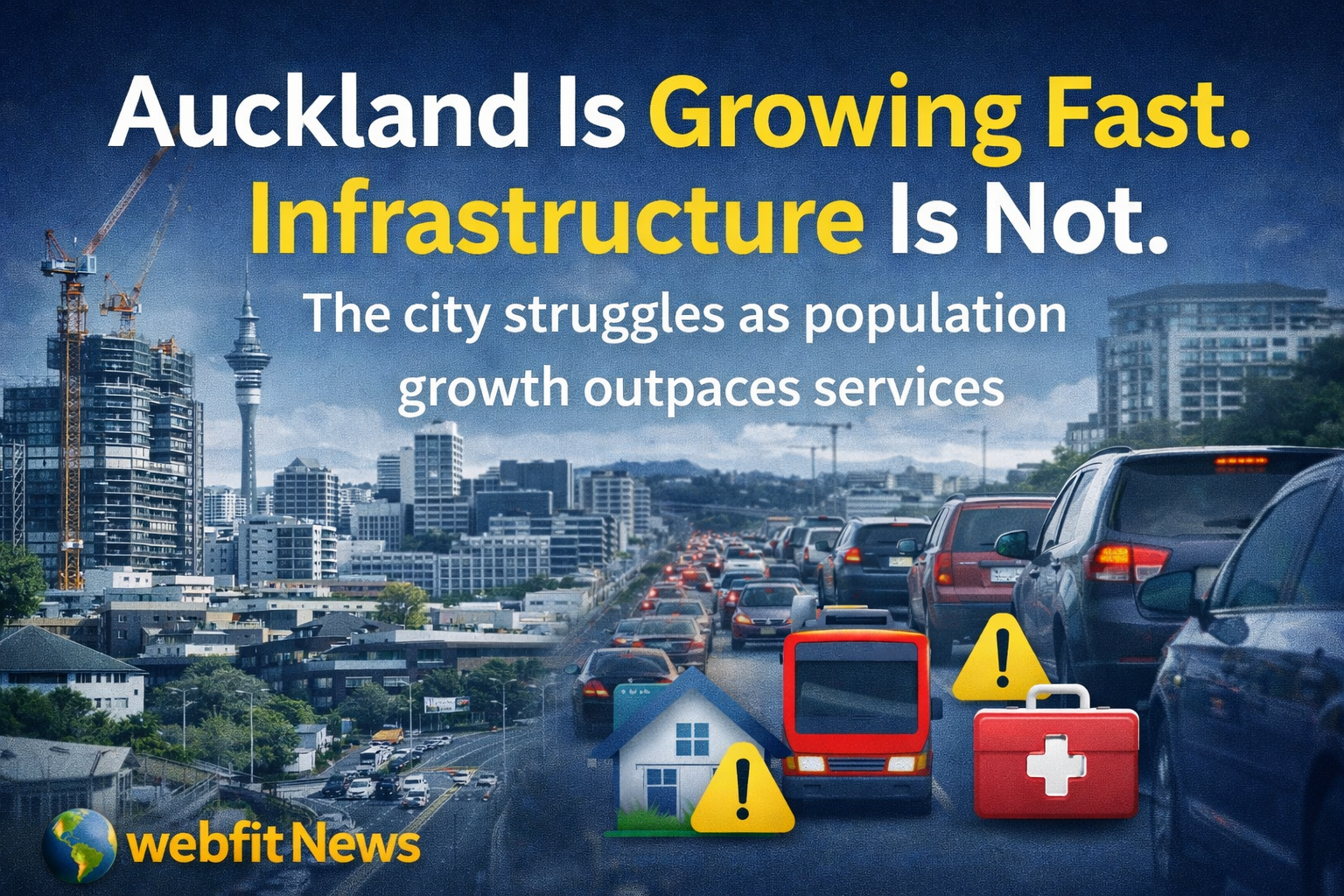
Auckland is growing again, and many residents feel it every day. Streets are busier, schools are fuller, clinics are stretched, and housing feels harder to access. This pressure is real. It reflects the lived experience of many Aucklanders in 2025.
However, the real issue is not population growth itself. The concern is Auckland infrastructure pressure and the widening gap between how fast the city is growing and how slowly its systems are catching up.
This gap is rarely discussed openly. When it is, the conversation often slips into politics or personal blame. As a result, one important question gets lost.
Who is responsible for making sure a growing city actually works?
Growth is back, but pressure never left
New Zealand’s population growth has rebounded strongly over the past two years. Auckland has absorbed the largest share of that increase. Migration has returned to levels not seen since before the pandemic. At the same time, natural population growth continues.
On paper, this growth brings clear benefits. A larger workforce supports businesses. A growing city attracts investment. Diversity strengthens culture and skills.
In practice, however, many Aucklanders feel the pressure first and the benefits later.
Rental viewings are crowded. GP appointments are harder to secure. Zoned schools rely on temporary classrooms. Public transport disruptions have become routine rather than exceptional.
This does not mean growth is wrong. Instead, it shows that growth without matching capacity creates friction.
Infrastructure moves slowly, while people do not
Infrastructure planning works on long timelines. Hospitals take years to design and build. Rail upgrades often span decades. Water networks and schools require sustained funding and coordination.
Population growth, however, does not wait.
When large numbers of people arrive within short periods, systems feel the impact immediately. Class sizes increase. Waiting lists grow. Roads clog before alternatives are ready.
This mismatch between planning cycles and real-time demand sits at the heart of Auckland infrastructure pressure. While the issue is not new, it has become far more visible in daily life.
The silent burden on everyday households
The consequences of this gap do not fall evenly.
Renters feel it through rising costs and housing insecurity. Families feel it when schools struggle to keep up. Workers feel it when transport delays extend daily commutes. Patients feel it when access to healthcare narrows.
For many middle-income households, the pressure is especially sharp. They earn too much to qualify for assistance but not enough to absorb rising costs easily. Over time, small stresses build into larger concerns.
This quiet squeeze rarely makes headlines. Yet it shapes how people experience Auckland every day.
Immigration is part of the picture, not the problem
It is important to be clear.
Immigration is not the problem. Migrants are not responsible for planning failures. In many cases, newcomers experience the same pressures as long-term residents, often more acutely.
The real issue is timing and coordination.
Population settings are national decisions. Infrastructure delivery is split across central government, councils, and agencies. When these systems fall out of sync, responsibility becomes blurred.
As a result, frustration grows without a clear place to direct it.
Accountability without accusation
This topic remains difficult partly because of fear. People worry about being misunderstood, mislabelled, or accused of inflaming division.
However, avoiding the discussion does not solve the problem. It simply allows frustration to grow quietly.
A neutral conversation does not ask who should leave or who should arrive. Instead, it asks practical governance questions:
- How are population forecasts used in infrastructure funding?
- What happens when growth exceeds projections?
- Who adjusts plans when assumptions change?
- How transparent are these decisions to the public?
These are planning questions, not cultural ones.
A city at a crossroads
Auckland is not broken, but it is strained.
Cities around the world face similar challenges. Those who succeed acknowledge pressure early and respond decisively. Those who struggle delay action until dissatisfaction hardens.
The real risk for Auckland is not growth itself. The risk is normalising overload.
When crowded hospitals, delayed transport, and housing stress become accepted as inevitable, ambition quietly lowers. Expectations shrink. That is not a future most Aucklanders want.
Why this conversation matters now
Year-end is a natural moment for reflection. It is when people look back and ask whether things are improving or simply being managed.
This conversation matters because it focuses on how Auckland plans its future, not who lives in the city.
It asks whether growth is supported by foresight or left to catch up later. It also asks whether residents feel heard before frustration turns into division.
Most of all, it asks for honesty.
A growing city deserves systems that grow with it.
The bottom line
Auckland’s challenge is not population growth. It is planning alignment.
Growth can be positive. Diversity can be a strength. Migration can be an opportunity.
However, without infrastructure that keeps pace, even the best intentions create pressure. Talking about that gap is not controversial because it is wrong. It is controversial because it has been avoided for too long.
Webfit News
News that fits fast life