
Introduction
Auckland is not usually where global industry disruption begins.
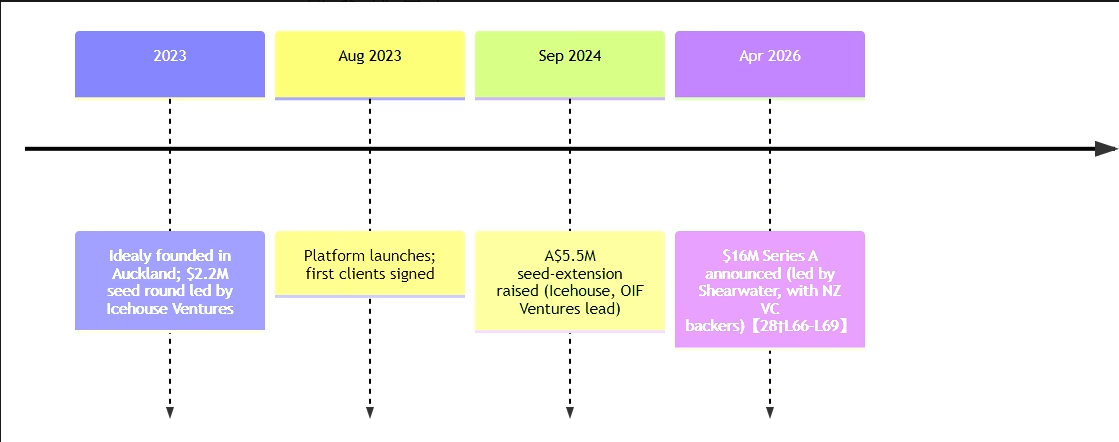
But an emerging startup, ideally, is starting to draw serious attention after raising NZ$16 million in new funding, taking its valuation beyond NZ$100 million.
At first glance, it looks like another tech funding story. In reality, it points to a deeper shift in how businesses understand their customers.
The Problem the Industry Has Ignored for Years
Market research has always been essential, but rarely efficient.
For decades, companies have relied on traditional research firms to test ideas, understand audiences, and validate decisions. The process is slow, often taking weeks, and expensive, sometimes costing tens of thousands of dollars for a single study.
In fast-moving markets, that delay creates a real problem. By the time insights arrive, the opportunity may already be gone.
That gap between speed and insight is where Ideally is positioning itself.
What Ideally Is Doing Differently
Instead of replacing traditional research entirely, Ideally focuses on one key improvement: speed.
Its platform allows companies to test ideas with real consumers and receive analysed results within 24 hours. AI is used to process responses quickly, but the data itself comes from actual human participants.
This distinction matters.
The company is not trying to simulate customers. It is trying to understand them faster.
For businesses making daily decisions around marketing, pricing, and product development, that shift can be significant.
| Company | Key Focus / Capabilities | Pricing Model | Market Positioning |
|---|---|---|---|
| Ideally | Fast, AI-driven creative and market research (Canvas + Overnight Testing) | ~US$10k per test; subscription/credits for enterprise | Self-serve, fast insights for marketers and innovation teams |
| NielsenIQ | Global analytics, large-scale consumer data, brand measurement | Custom enterprise contracts (high cost) | Legacy industry leader with full-market measurement |
| Kantar | Broad research tools, automated panels, global studies | Pay-as-you-go or custom enterprise pricing | Large global research firm with deep datasets |
| Qualtrics | Enterprise survey and experience management platform | Subscription-based (approx. US$6k to $126k annually) | Feature-rich platform for large organisations |
| Attest | AI-powered on-demand surveys with global panels | Flat fee per audience segment | Easy-to-use platform for fast consumer insights |
Why This Matters Beyond New Zealand
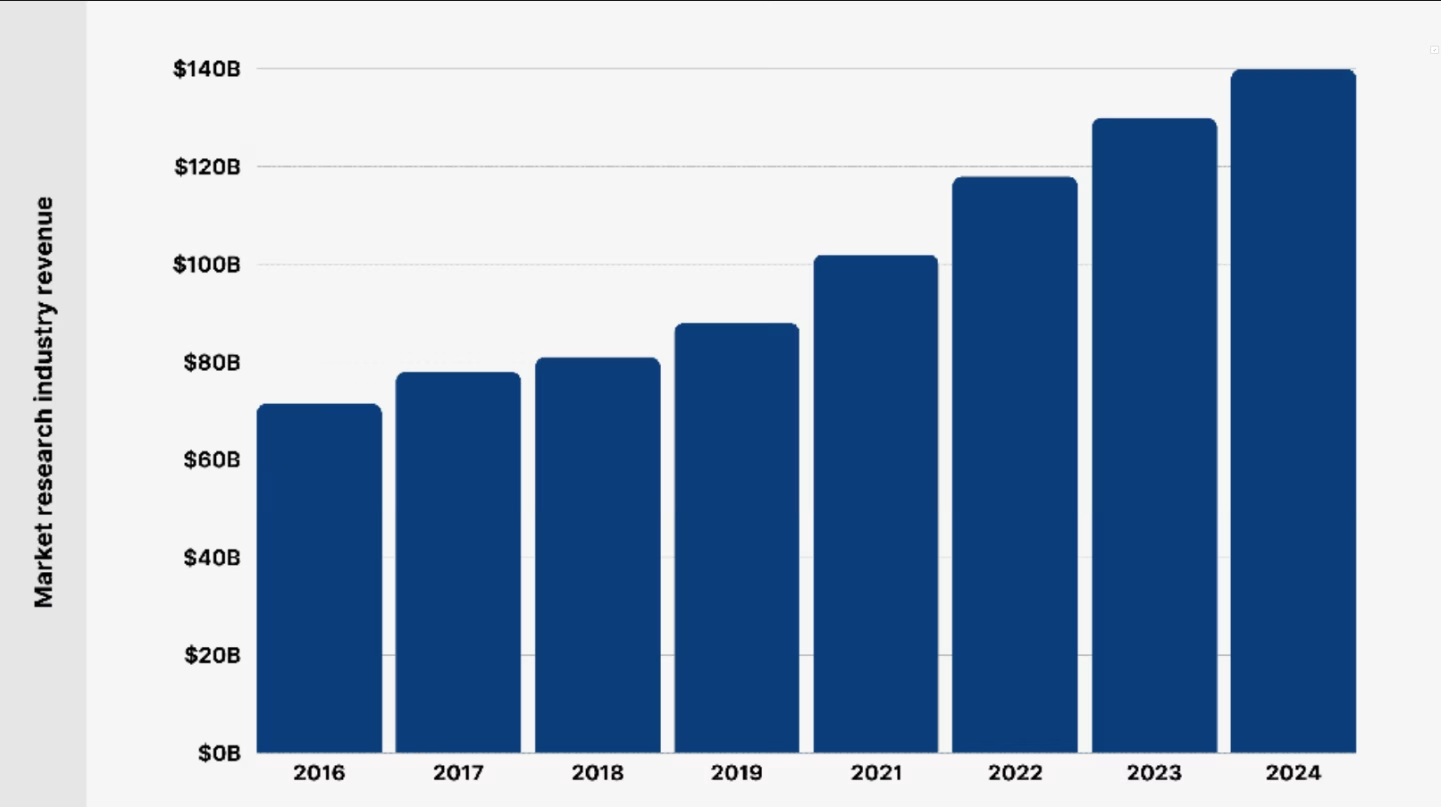
The global market research industry is worth well over $100 billion, dominated by established players such as NielsenIQ and Kantar.
These companies provide depth, scale, and long-term data. But they are built for a different era, where decisions moved more slowly, and budgets were larger.
Today, companies operate in shorter cycles. Campaigns launch faster, consumer behaviour shifts quickly, and competition is constant.
In that environment, speed is no longer a luxury. It is a requirement.
Startups like Ideally are not replacing the giants outright. They are targeting a specific weakness in the system.
Built in Auckland, Designed for the World
Building a global SaaS company from Auckland comes with obvious challenges. Distance from major markets, limited access to capital compared to the US, and a smaller domestic base all add pressure.
But those same constraints often create focus.
New Zealand startups tend to:
- Solve specific problems instead of broad ones
- Build lean teams that move quickly
- Design products for international markets from the start
Ideally reflects that approach. It has already secured a global client base, showing that the product resonates beyond its home market.
The Next Step: Entering the US Market
With fresh funding in place, the company is now turning its attention to North America.
The reasoning is straightforward. The US market has larger marketing budgets, higher demand for rapid insights, and a concentration of global brands.
But expansion into the US is also where many startups struggle.
Enterprise customers are harder to win, competition is intense, and expectations around performance and reliability are significantly higher.
Opening a New York presence is a logical move. Whether it translates into sustained growth is the real question.
The Risks That Come With Speed
Despite the momentum, there are real challenges ahead.
Trust in AI-driven analysis remains an issue. Businesses will adopt faster tools only if they believe the insights are reliable.
Data privacy is another concern. Operating across markets means complying with strict regulations, and any failure could damage credibility.
Competition is evolving. Established players are investing heavily in AI and will not give up market share easily.
Budget pressure also matters. In uncertain economic conditions, research spending is often reduced before other priorities.
Webfit News Perspective
The significance of ideally is not just about technology. It is about access.
For a long time, high-quality consumer research was available mainly to large organisations with significant budgets. Faster, more affordable tools lower that barrier.
That has the potential to change how decisions are made, particularly for mid-sized companies and growing brands.
But speed introduces its own risk.
Fast insights are only valuable if they are accurate. If quality drops, businesses may end up making poor decisions more quickly rather than better ones.
The long-term success of companies like Ideally will depend less on how fast they deliver results, and more on how much those results can be trusted.
Conclusion
Ideally has reached a critical point in its journey.
The funding signals confidence. The product has found early traction. The global ambition is clear.
What comes next will determine whether this is a short-term success story or a company that reshapes its industry.
Breaking into the US market, maintaining trust in its insights, and staying ahead of both startups and established competitors will define the next phase.
For now, one thing is evident.
Auckland is not just producing startups. It is producing companies willing to challenge global systems.
References
- Company reports and industry data on global market research trends
- Public statements from investors and founders