By Webfit News
New Zealand Reviews Investor Visa Rules Amid Concerns Over Idle Capital – WebfitNews
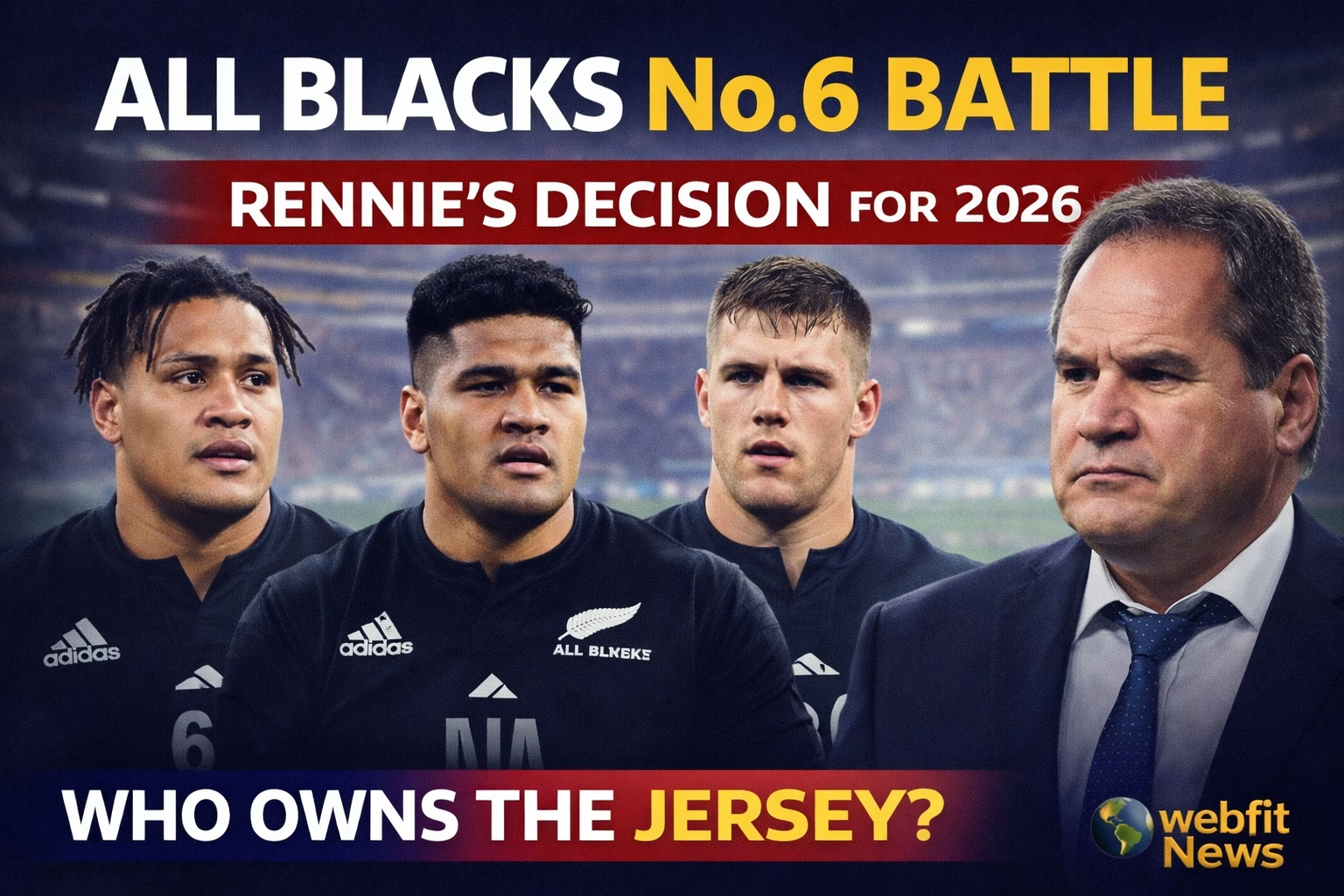
There are some positions in rugby where debate never really ends.
The All Blacks No.6 jersey has quietly returned to that category.
After a brief period of stability under Shannon Frizell, the position has once again become unsettled. Now, with Dave Rennie stepping into the role in 2026, the question is no longer about options. It is about clarity.
New Zealand does not lack talent at blindside flanker. What it lacks is a decision.
timeline
    title All Blacks No.6 selections since the 2023 World Cup
    2023 : Frizell leaves New Zealand after the World Cup
    2024 : July - Finau starts against England twice
         : July - Jacobson starts against Fiji
         : August to September - Blackadder starts against Argentina twice and South Africa in Johannesburg
         : September to November - Sititi starts in Cape Town, both Wallabies tests, England, Ireland and Italy
         : October to November - Finau returns as starter against Japan and France
    2025 : July - Vaa'i starts the first two France tests
         : July - Finau starts the Hamilton decider
         : August - Vaa'i starts both Argentina tests
         : September to November - Parker starts against South Africa twice, Australia twice, Ireland, England and Wales
         : November - Sititi is recalled to start against Scotland
Why This Position Matters Again
Frizell’s departure after the 2023 World Cup created a gap that has not been properly filled.
Over the 2024 and 2025 seasons, the All Blacks used multiple players at No.6 across 27 Tests. That is not rotation. That is uncertainty.
The modern blindside role has evolved. It is no longer just about tackling hard and cleaning rucks. The best teams now expect their No.6 to bring:
- Lineout presence
- Physical dominance in collisions
- Mobility across the field
- Ability to contribute in attack
New Zealand has tried to tick all those boxes. The problem is, each player ticks some, not all.
The Current Contenders
Wallace Sititi – The Highest Ceiling
Sititi has shown something the others have not consistently delivered.
Impact.
His performances in key matches proved he can shift momentum, not just maintain it. He carries strongly, defends aggressively, and has the ability to break a game open.
The concern is not talent. It is continuity. Injuries have interrupted his rhythm.
Still, when he plays well, the difference is visible.
Simon Parker – The Cleanest Fit
The No.6 Rotation in Numbers
Across the 2024 and 2025 Test seasons, the All Blacks rotated heavily at blindside flanker. The numbers show how unsettled the role has been:
| Player | No.6 Starts (2024–25) | Latest Cap Marker | Lineout and Ball Profile | Injury / Availability Note | Verdict |
|---|---|---|---|---|---|
| Wallace Sititi | 7 | 18 | Secondary jumper, explosive carrier, strong defensive range | Missed 2025 France series due to ankle surgery | Best all-round upside, most damaging athlete |
| Simon Parker | 7 | 8 (debut season) | Genuine lineout option, 1.97m/119kg frame, carries both edge and middle | Late ankle setback delayed 2025 progress | Closest to a specialist modern No.6 |
| Tupou Vaa’i | 4 | 45 | Strong aerial option, adds maul and set-piece strength | Injury in Hamilton, later knee issue | Effective hybrid, but still a lock playing six |
| Samipeni Finau | 5 | 11 | Physical tackler, direct runner, limited lineout value | Absence late 2025 due to family reasons | Early frontrunner who lost momentum |
| Ethan Blackadder | 3 | 15 | High work rate, strong defensively, limited aerial presence | Hamstring and calf injuries disrupted season | Raises team floor when fit, but availability remains an issue |
| Luke Jacobson | 1 | 24 | Intelligent link player, strong support lines, covers No.8 | Multiple injuries including hamstring, thumb and concussion | Missed the 2025 France series due to ankle surgery |
If you are building a modern blindside from scratch, it probably looks like Simon Parker.
He brings:
- Height and lineout value
- Physical presence
- Positional flexibility
Coaches value predictability, especially in tight contests. Parker offers that structure. He may not be as explosive as Sititi, but he makes the team more balanced.
Tupou Vaa’i – The Hybrid Option
Vaa’i solves one problem and creates another.
He adds:
- Strong aerial presence
- Extra size in the pack
- Set-piece control
But he is still, fundamentally, a lock playing as a flanker. That trade-off matters.
You gain lineout strength, but risk losing mobility in open play.
The Others – Valuable but Not Convincing
- Samipeni Finau had early momentum but could not sustain it
- Ethan Blackadder raises the team’s work rate but struggles with availability
- Luke Jacobson offers versatility but lacks dominance in the role
All three are useful. None have made the position their own.
That is the reality.
The Bigger Issue: Rotation Without Direction
Depth is usually a strength.
But in this case, it has become a problem.
Over two seasons, the All Blacks experimented with combinations depending on opposition and conditions. That flexibility sounds smart, but it has led to a lack of identity in the back row.
At some point, “different” has to become “better.”
That moment is now.
What Rennie Needs to Do
Dave Rennie does not inherit a broken system. He inherits an unfinished one.
His task is simple in theory, difficult in execution.
He must pick a direction and stay with it.
Option 1: Back Sititi
If Rennie wants attacking impact and game-breaking ability, Sititi is the logical choice.
He offers the highest upside.
Option 2: Build Around Parker
If the focus is structure, balance, and set-piece reliability, Parker becomes the safer option.
This approach suits matches where control matters more than flair.
Option 3: Use Vaa’i Strategically
Vaa’i should not be the default choice.
He should be used when the opposition demands extra size and lineout strength.
Recommended Approach
The decision does not need to be complicated.
- Start Sititi when fully fit
- Keep Parker in the matchday 23 consistently
- Use Vaa’i selectively based on opposition
- Treat the rest as depth, not rotation
Anything less defined risks repeating the same cycle.
Webfit News Perspective
This is not just a selection issue. It is a leadership moment.
The All Blacks do not need more experiments at No.6. They need conviction.
For two years, the position has been shaped by options.
Now it needs to be defined by decision.
Because in elite rugby, clarity is often the difference between competing and winning.
Conclusion
The All Blacks have the players.
What they need now is stability.
Rennie’s first real test may not come on the scoreboard. It will come in selection.
And the No.6 jersey is where that decision will be judged first.
References
- Official team selections and match reports from New Zealand Rugby (NZR) and SANZAAR (2024–2025 Test seasons)
- Player statistics and caps data from All Blacks Official Stats
- Match performance coverage and analysis from NZ Herald, Otago Daily Times, and RugbyPass
- Reporting on Shannon Frizell’s move to Japan from Reuters (August 2023)
- Squad announcements and coaching comments from All Blacks media releases (2024–2025 seasons)