Air New Zealand says its flight reliability improved significantly in July compared with the same month last year, with fewer cancellations, fewer knock-on delays and new technology reducing the time some disrupted passengers wait to be rebooked.
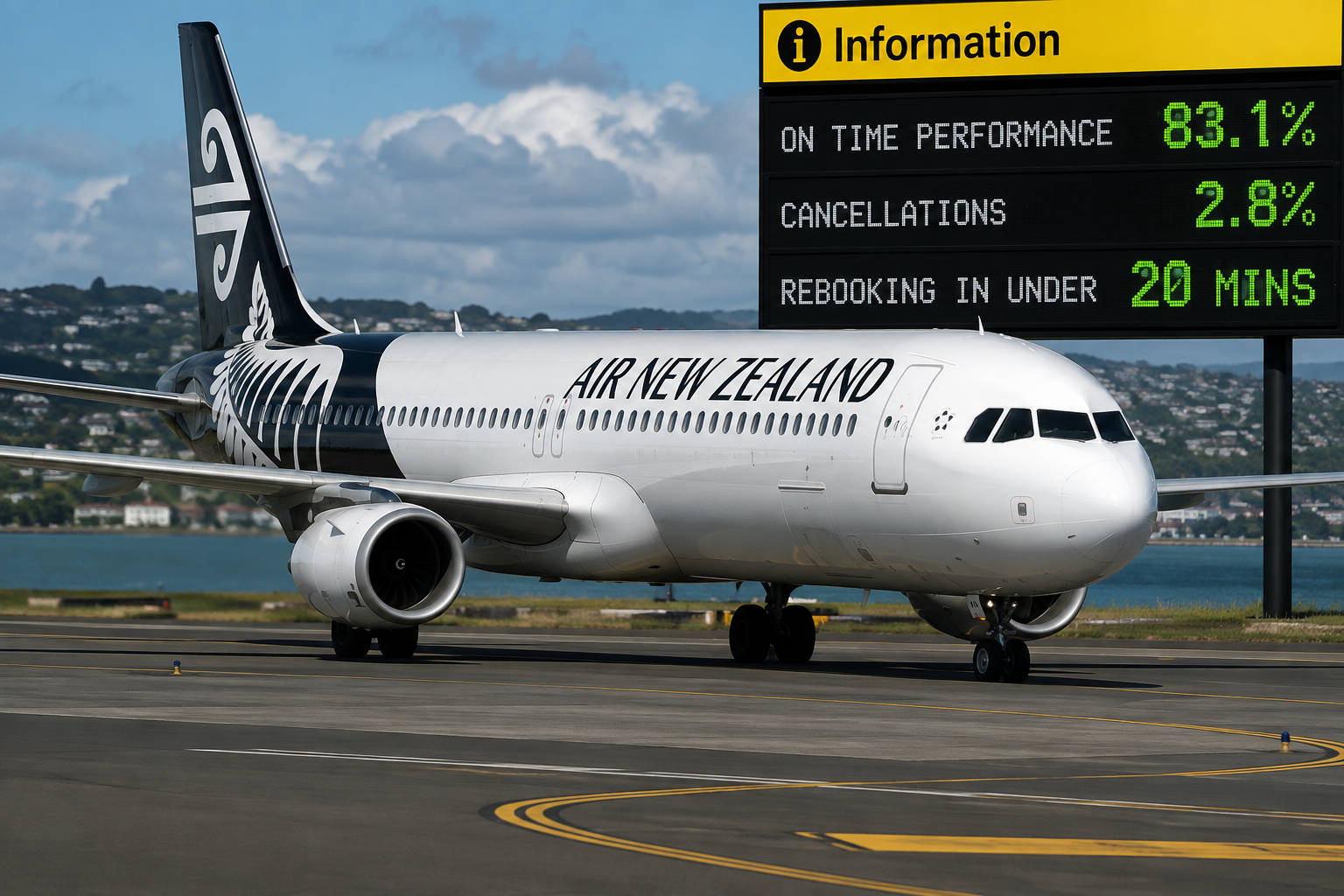
The airline reported that 83.1 percent of its July flights arrived within 15 minutes of schedule, an improvement of 6.4 percentage points compared with July 2025.
The figure was lower than the 86 percent on-time performance recorded in June, but Air New Zealand said the year-on-year improvement was achieved despite weather-related delay minutes being 74 percent higher than in July last year.
The airline operated 13,397 domestic and international flights during July 2026.
## Fewer cancellations despite more weather disruption
Air New Zealand Chief Operations Officer, Ground and In-Flight, Kate Boyer said the latest figures showed progress in an area passengers consistently care about.
Compared with July last year, the airline recorded 246 fewer cancellations.
International on-time performance improved by more than nine percentage points, while performance at Auckland, Air New Zealand's largest and most operationally complex hub, improved by almost 10 percentage points.
Boyer said the airline's focus was not only on preventing disruptions but also on recovering more quickly when problems occurred.
"We know reliability is one of the things our customers value most," she said.
"Our focus is on reducing disruption in the first place, and when it does happen, recovering quickly and making the experience as easy as possible for our customers."
## Knock-on flight delays fall sharply
One of the largest contributors to the improvement was a reduction in what the airline calls "reactionary delays".
These occur when one delayed aircraft or flight causes subsequent services to depart or arrive late later in the day.
Air New Zealand said reactionary delay minutes fell by 41 percent compared with July 2025.
That meant 1,366 fewer flights were affected by knock-on delays compared with the same month last year.
The figure is significant because airline disruptions can spread quickly across a network.
A late aircraft, delayed crew or disrupted airport turnaround can affect multiple services after the original problem has passed.
Boyer said faster recovery reduced the risk of passengers on later flights being caught in disruption caused earlier in the day.
"The faster we can recover, the better chance we have of preventing that disruption from affecting customers travelling later in the day," she said.
## Cancellation rate drops to 2.8 percent
Air New Zealand said its overall cancellation rate fell by 1.6 percentage points year on year to 2.8 percent.
That represented 246 fewer cancelled flights than in July 2025.
Cancellations considered to be within Air New Zealand's control also fell.
The airline reported a 1.2 percentage point reduction in controllable cancellations, bringing the rate down to 1 percent.
That equated to 184 fewer cancellations compared with July last year.
Weather remains one of the biggest factors airlines cannot directly control, particularly during New Zealand's winter months.
Air New Zealand's July figures suggest the airline was able to improve its overall operational performance despite experiencing substantially more weather-related disruption than a year earlier.
## New rebooking technology targets long disruption waits
Air New Zealand is also expanding technology designed to reduce the amount of time passengers wait for alternative flights after a cancellation.
Its Automated Passenger Rebooking system, known as APR, was introduced for domestic flights in mid-2025 and is now being extended to international cancellations.
Before the system was introduced, Air New Zealand said rebooking customers after a cancelled flight could take several hours.
For some long-haul international cancellations, the process could take between four and six hours.
The airline says passengers with relatively straightforward itineraries can now, in some cases, be rebooked in under 20 minutes.
Passengers are also able to consider another available flight if the automatically selected replacement does not suit them.
For travellers stuck at an airport or dealing with the cancellation of an international journey, reducing the rebooking process from several hours to minutes could substantially change the disruption experience.
## Staff freed to deal with complicated cases
Automation does not mean every passenger can be rebooked instantly.
Customers travelling on more complicated itineraries, including journeys involving connecting airlines or special requirements, may still need assistance from Air New Zealand staff.
The airline says that is another reason for introducing the technology.
By automatically handling straightforward cases, customer service teams can spend more time assisting passengers whose journeys require human intervention.
Boyer said feedback since the domestic rollout had been positive and the airline was beginning to see similar responses as the technology expanded internationally.
"Going from potentially hours to minutes for some rebookings is a huge improvement for our customers," she said.
"It means they have certainty sooner and more control over what happens next, while our teams can focus their time on customers with more complex journeys or those who need extra care and support."
## Reliability remains a key test for passengers
Air New Zealand's latest numbers point to a clear year-on-year improvement, although the decline in on-time performance from 86 percent in June to 83.1 percent in July shows that monthly results can still fluctuate significantly.
Weather, aircraft availability, airport congestion, engineering requirements and delays elsewhere in the network can all affect airline schedules.
For passengers, however, the practical test is simpler: whether their flight leaves on time, whether it is cancelled and how quickly the airline can find an alternative when something goes wrong.
The July figures suggest Air New Zealand is making progress on those measures compared with a year ago.
The expansion of automated international rebooking will now provide another test of whether technology can make unavoidable disruption less stressful for travellers.
## Cargo operations continue alongside passenger network
Air New Zealand also carried 14,149 tonnes of cargo across its network during July.
That included 370 tonnes of frozen seafood and salmon exported to North America, highlighting the airline's role not only in passenger transport but also in moving time-sensitive New Zealand exports into international markets.
### Source
This article is based on operational data and statements supplied by Air New Zealand Communications in a media release issued under embargo until 5am on 19 August 2026.
The operational performance figures, cancellation statistics, cargo volumes and rebooking times cited in this article are Air New Zealand figures.