By Geet G | Webfit News
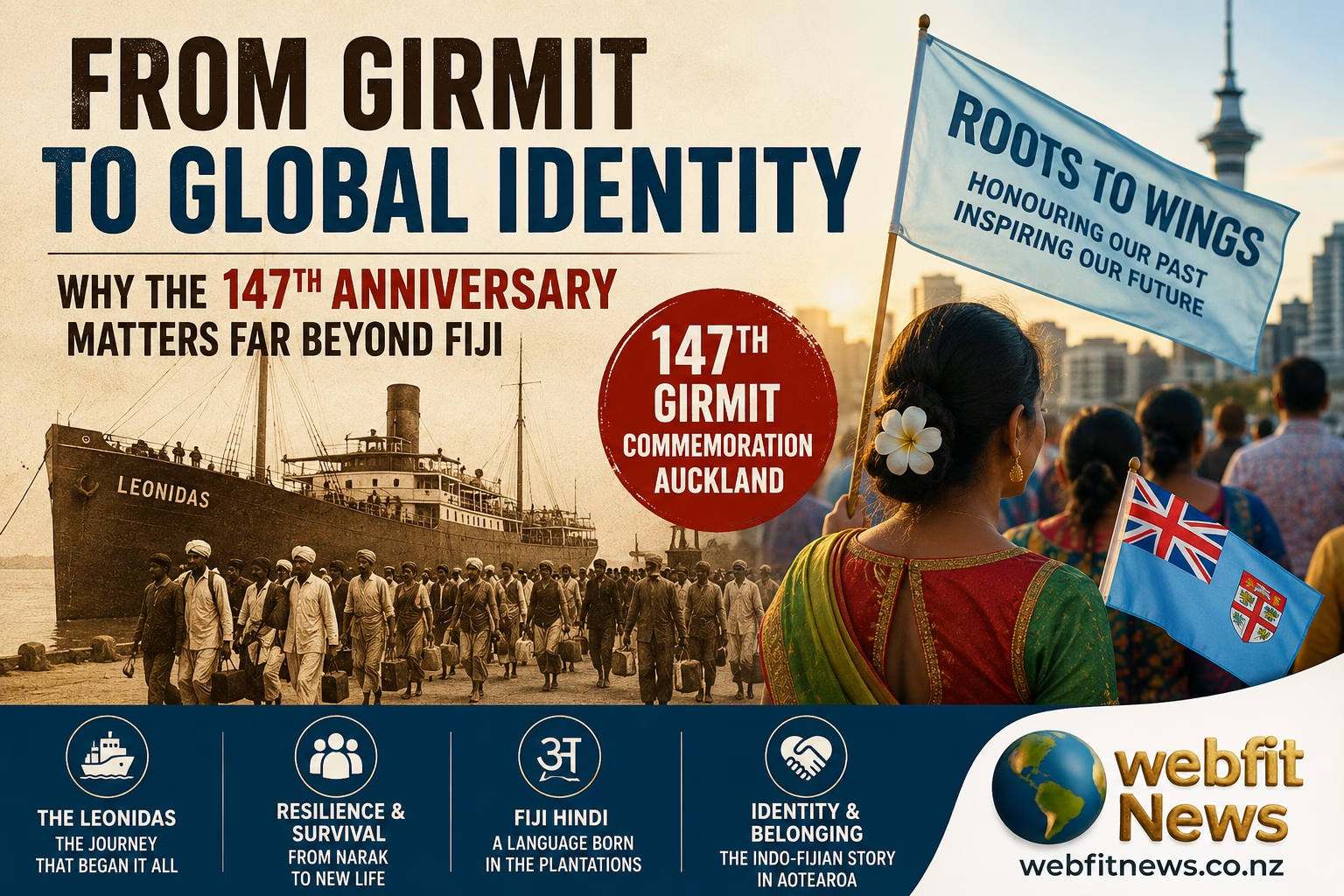
On 14 May 1879, a ship called the Leonidas arrived in Fiji carrying hundreds of Indian labourers who had crossed the kala pani, the “black waters,” under a colonial indenture contract they barely understood.
147 years later, their descendants are no longer just plantation workers’ families struggling for survival.
They are politicians, academics, business owners, teachers, lawyers, doctors, journalists, and community leaders spread across Fiji, New Zealand, Australia, Canada, the United States, and beyond.
But behind that success story sits one of the most painful and under-discussed chapters of colonial history in the Pacific.
This week, as the Indo-Fijian diaspora gathers for the 147th Girmit Commemoration in Auckland, the event is not simply about remembering ancestors.
It is about reclaiming historical memory, protecting identity, and asking difficult questions about migration, race, belonging, and what it means to be “Pacific” in the modern world.
The story of Girmit is no longer just Fiji’s story.
It has become part of New Zealand’s multicultural story too.
The System That Replaced Slavery
The Girmit system emerged after the British Empire abolished slavery in 1833.
Plantation economies across the empire immediately faced a labour crisis.
Sugar plantations still needed workers, but slavery had officially ended.
So the empire created another system.
Indentured labour.
Between the 1800s and early 1900s, more than one million Indians were transported to British colonies under labour agreements that promised wages, accommodation, and eventual freedom. In reality, many workers faced brutal exploitation, deception, poverty, violence, and social isolation.
In Fiji, the system began under Governor Sir Arthur Gordon, who believed indigenous iTaukei communities should be protected from plantation labour. Instead, Indian workers were brought in to sustain the colony’s sugar economy.
The labour contract became known locally as “Girmit,” a Fiji Hindi pronunciation of the English word “Agreement.”
That word would later become one of the defining identity markers of Indo-Fijian history.
Between 1879 and 1916, more than 60,000 Indians arrived in Fiji through the Girmit system.
Many never returned home.
The Voyage That Changed Pacific History
The first ship, the Leonidas, left Calcutta carrying 463 passengers.
The voyage itself was traumatic.
Disease spread rapidly onboard. Cholera, dysentery, and smallpox killed several passengers before the ship even reached Fiji.
When it finally arrived near Levuka, authorities quarantined the vessel on Yanuca Lailai island due to fears of infection.
That moment marked the birth of the Indo-Fijian community.
Most passengers had no idea where Fiji truly was.
Many had reportedly been misled by recruiters called arkatis, who targeted poor and vulnerable villagers in India with promises of opportunity and easy work.
Instead, they arrived in a plantation system built around exhausting labour and colonial discipline.
The emotional rupture was enormous.
Families were separated forever.
Traditional caste systems collapsed under plantation life.
Workers from different regions, religions, and languages were forced to live together inside cramped barracks known as “coolie lines.”
Yet from that suffering, something entirely new emerged.
A new language.
A new identity.
A new Pacific Indian culture.
How Fiji Hindi Was Born
One of the most extraordinary outcomes of the Girmit system was the development of Fiji Hindi.
Labourers arrived speaking Bhojpuri, Awadhi, Magahi, Tamil, Telugu, Urdu, and other Indian languages and dialects.
Inside plantations, they needed a common way to communicate.
Over time, those dialects blended together with English and iTaukei influences to create Fiji Hindi.
Today, Fiji Hindi is not just a language.
It is a cultural archive.
It carries the humour, pain, songs, oral histories, and emotional memory of Girmitiyas.
That is why many Indo-Fijian organisations in New Zealand now push for stronger recognition of Fiji Hindi as a heritage language worth preserving.
The concern is real.
As younger generations assimilate into English-speaking societies, many diaspora families fear losing direct connection to their Girmit roots.
Plantation Life Was Often Hellish
Historical records describe plantation life as physically brutal and psychologically devastating.
Workers laboured long hours under the “task” system for extremely low wages.
Housing was overcrowded and unsanitary.
Women faced severe vulnerability, including harassment and sexual violence.
Suicide rates during the indenture period became alarmingly high.
Many Girmitiyas referred to the experience as narak, meaning hell.
Yet despite this, the community endured.
Religion survived.
Music survived.
Festivals survived.
Oral storytelling survived.
Eventually, many former labourers transitioned into farming, business, education, and public life after completing their contracts.
That transformation remains one of the most remarkable resilience stories in Pacific history.
The Syria Tragedy and a Different Kind of Legacy
Another major chapter remembered during Girmit commemorations is the wreck of the Syria in 1884.
The ship struck the Nasilai Reef while carrying indentured passengers to Fiji.
Dozens died.
But the tragedy also produced one of the most powerful moments of inter-ethnic solidarity in Fiji’s history.
iTaukei villagers risked their lives in dangerous seas to rescue survivors.
That rescue effort remains deeply symbolic today.
In modern Fiji, many leaders now point to the Syria rescue as evidence that Indo-Fijian and iTaukei histories are not separate stories, but interconnected ones.
This matters because Fiji’s political history after independence was often shaped by ethnic division, coups, distrust, and racial tension.
The Girmit commemorations increasingly try to move the narrative away from division and toward shared national history.
Why Auckland’s Commemoration Matters
The 147th Girmit Commemoration in Auckland is being organised by the Fiji Girmit Foundation of New Zealand.
The event at Māngere’s Malaeola Community Centre is expected to bring together community elders, political representatives, families, and younger generations.
The structure of the event itself reveals something important.
This is not simply a cultural show.
It combines interfaith prayers, educational storytelling, historical role plays, children’s speeches, candlelight vigils, and recognition of senior descendants.
That mix reflects a deeper purpose.
The organisers are trying to preserve institutional memory before it disappears.
Because once oral history dies with older generations, communities often lose their emotional connection to the past.
That is why medal presentations to senior descendants carry symbolic weight.
The elders are not just guests.
They are living archives.
The Identity Debate Inside New Zealand
One of the most politically significant aspects of the modern Indo-Fijian story is happening right now in New Zealand.
Many Indo-Fijians argue that being automatically categorised as simply “Asian” fails to capture their Pacific identity.
Their argument is not entirely emotional.
It is historical.
Their ancestors have lived in the Pacific for nearly 150 years.
Their language evolved in the Pacific.
Their culture evolved in the Pacific.
Their migration experience differs significantly from more recent South Asian migration patterns.
Some organisations, including the Fiji Girmit Foundation of New Zealand, have openly pushed for stronger Pasifika recognition.
This debate could eventually influence census classification, policy development, education frameworks, and health resource allocation.
It also raises a broader question New Zealand increasingly faces:
How should multicultural identity actually be defined in a super-diverse Pacific nation?
A Story Bigger Than Victimhood
What makes the Girmit story powerful is that it does not end in victimhood.
Yes, the system was exploitative.
Yes, it caused generational trauma.
But the descendants of Girmitiyas transformed that suffering into social mobility, education, entrepreneurship, and community leadership across the Pacific and beyond.
That transformation matters.
Because historical memory without forward movement becomes trapped in grief.
The modern Girmit narrative increasingly focuses not only on pain, but also on survival, dignity, adaptation, and contribution.
That shift is visible in the theme many organisers now promote:
From roots to wings.
The Webfit News Perspective
The Girmit story deserves far greater recognition in New Zealand society than it currently receives.
Not as a niche ethnic history lesson.
But as a major Pacific migration story tied directly to colonialism, labour exploitation, identity formation, and multicultural evolution.
Too often, Indo-Fijian identity gets flattened into generic labels that fail to reflect its unique historical journey.
The 147th anniversary is not just about looking backward.
It is about ensuring younger generations understand why their grandparents spoke differently, worshipped differently, migrated differently, and carried emotional memories that cannot always be explained through textbooks alone.
Because communities that lose historical memory eventually lose cultural confidence too.
And perhaps that is why the Girmit Flame still matters after 147 years.
Not because the pain continues.
But because the memory does.