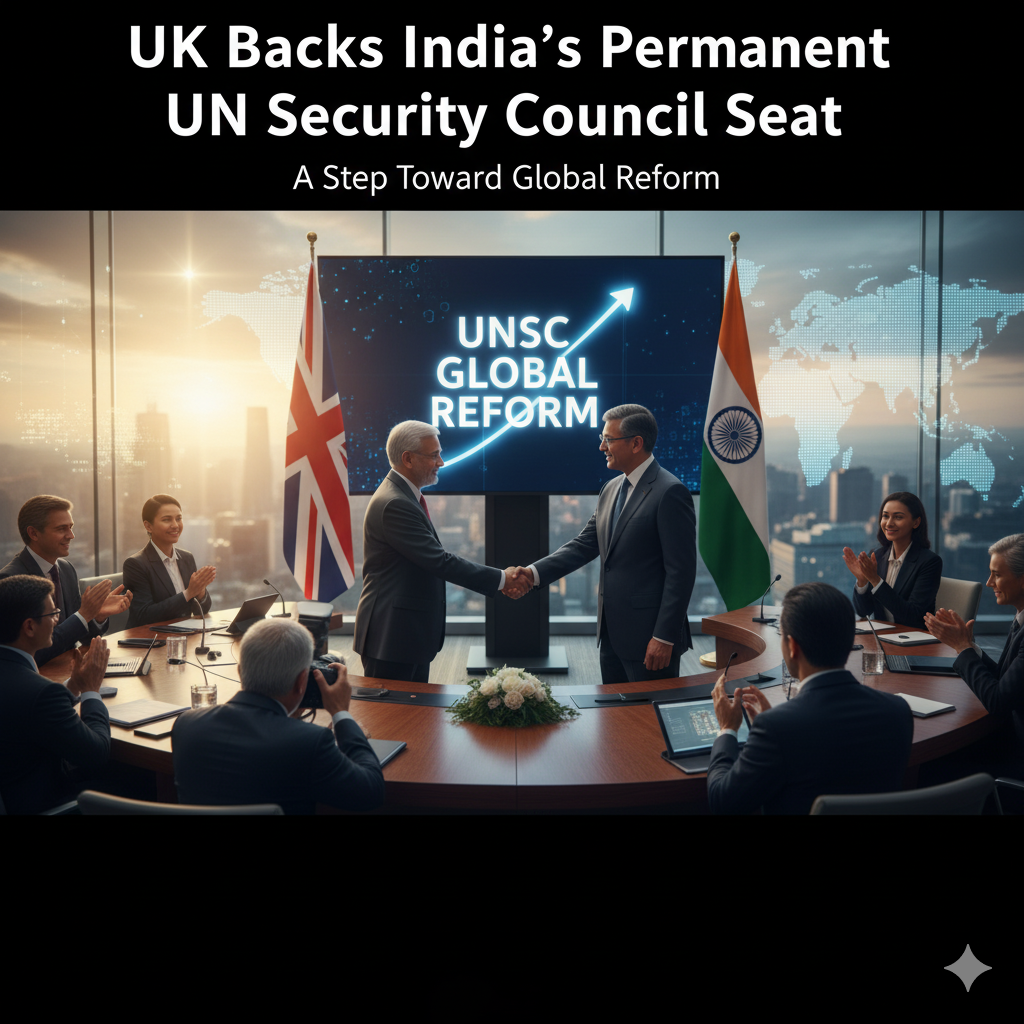
UK Prime Minister Sir Keir Starmer joins global leaders in supporting India’s permanent seat on the UN Security Council, recognizing India’s growing global influence and contribution to peace and development.
India’s Long-Standing Demand Gains Global Momentum
India’s decades-old call for a permanent seat on the United Nations Security Council (UNSC) received strong backing this week from UK Prime Minister Sir Keir Starmer.
During his meeting with Prime Minister Narendra Modi in Mumbai, Starmer said that India deserves its “rightful place” in the UN’s highest decision-making body.
This endorsement adds to a growing list of powerful supporters, including the United States, France, Germany, Japan, Brazil, and the African Union. Together, these nations argue that the UNSC must evolve to reflect today’s global realities rather than the post-World War II world it was built for.
Who Currently Holds Power in the UN Security Council
The UN Security Council has 15 members:
- Five permanent members (P5): the United States, the United Kingdom, Russia, China, and France.
- Ten non-permanent members: elected for two-year terms by the UN General Assembly.
At present, China is the only Asian country with a permanent seat. India, despite being the world’s most populous nation and a major economic and military power, remains outside the P5 circle.
Global Support for India’s Inclusion
Over the last few years, India’s call for reform has gathered worldwide support:
- Russia has repeatedly said it supports greater representation from Asia, Africa, and Latin America.
- UN Secretary-General António Guterres acknowledged India’s position in 2023, saying he “fully understands” the demand but that reform must come through consensus among member states.
- External Affairs Minister S. Jaishankar, speaking at a BRICS summit, urged that the world needs a “more equitable global order” by reforming outdated institutions like the UNSC.
Why the UK’s Support Matters
The UK’s statement is significant because it comes amid renewed global debates on UN reform and India’s growing global influence.
Starmer’s remarks follow a series of recent high-level endorsements from Western powers, signaling a shift in international thinking toward a more representative global system.
India’s participation is seen as key to balancing global decision-making, especially in Asia where China’s presence dominates. With deep democratic roots, peacekeeping contributions, and economic growth, India is being recognized as a responsible global player.
Trade and Cooperation Strengthen India–UK Relations
Beyond the UN discussions, the meeting also celebrated stronger ties between India and the United Kingdom:
- A trade deal signed in July will see India reduce tariffs on British goods like whisky, cosmetics, and medical devices.
- The UK will cut duties on clothing, footwear, and food products.
- Bilateral trade between the two countries is worth around USD 54.8 billion, supporting over 600,000 jobs across both nations.
Starmer praised India’s “remarkable growth story,” while PM Modi called India and the UK “natural partners” working together to promote global stability, technology innovation, and cultural exchange from Bollywood to football.
The Road Ahead
India’s campaign for a permanent UNSC seat is likely to continue gaining diplomatic traction. Yet, any reform requires broad consensus among member nations, making it a slow and complex process.
As PM Modi said, the two nations are building “a crucial foundation for global stability and economic progress.”
If the global momentum continues, India’s “rightful place” at the UNSC table may finally be within reach.
References
- United Nations – Security Council Overview: https://www.un.org/securitycouncil
- Ministry of External Affairs, Government of India – Statements on UNSC Reform
- BBC News: “UK Backs India’s Bid for Permanent UN Security Council Seat” (2025)
- Reuters: “Global Leaders Support India for Permanent UNSC Membership”
- The Guardian: “UN Reform Talks Gain Momentum Amid Growing Calls for Inclusivity”