
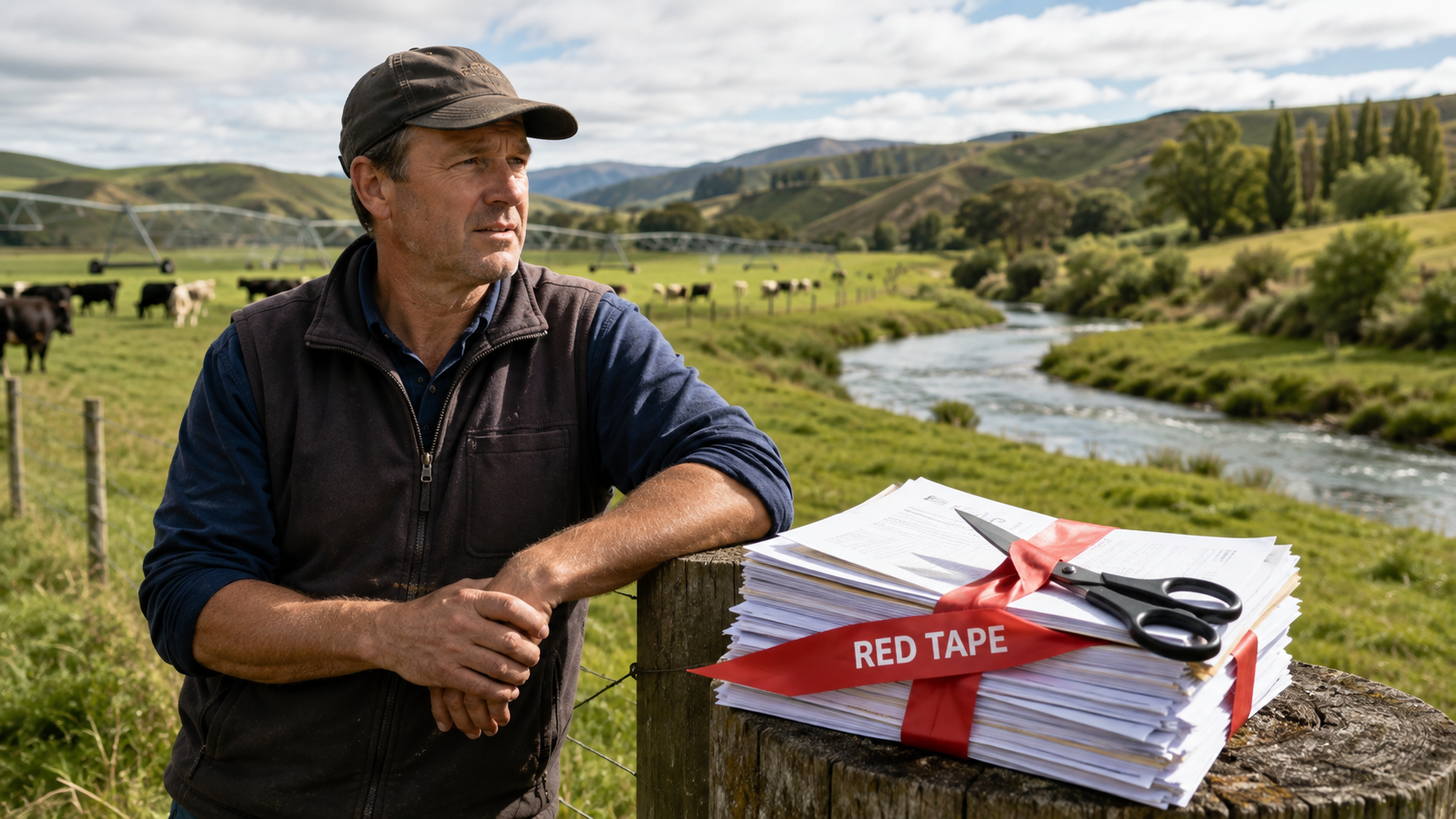
RMA Reform Takes a Farmer-Friendly Turn, but the Real Test Will Be What Happens on the Ground
New Zealand’s overhaul of the Resource Management Act is moving into a new phase, with the Government making several changes aimed at reducing cost, complexity and uncertainty for farmers.
Federated Farmers has welcomed the latest changes, saying they address some of the biggest concerns raised by the rural sector.
For the public, the issue is not simply about cutting paperwork.
The bigger question is whether New Zealand can make farming and development easier without weakening protections for water, land and biodiversity.
What is changing?
The Government is progressing two major laws to replace the Resource Management Act:
- the Planning Bill
- the Natural Environment Bill
The latest changes are intended to make the new system more practical for farmers and rural communities.
Here is a simple summary.
|
Issue |
Earlier concern |
Proposed change |
Why it matters |
|
Resource caps |
Farmers feared limits on fertiliser, stock numbers or land use |
Resource cap provisions to be removed |
Reduces risk of blanket restrictions |
|
Existing farming activity |
Six-month recognition period |
Extended to 12 months |
Better reflects annual farming cycles |
|
Environmental management |
Concern about rigid controls |
Greater use of action plans |
Allows catchment-specific responses |
|
Biodiversity |
“No net loss” wording seen as unclear |
Focus on significant biodiversity |
Could provide clearer land-use rules |
|
Water infrastructure |
Long-term investment uncertainty |
Longer permit certainty proposed |
Helps support investment decisions |
Why farmers were worried about resource caps
One of the biggest concerns involved the idea of resource caps.
In simple terms, councils could have been required to set maximum levels of resource use before an environmental limit was breached.
Federated Farmers feared this could eventually translate into controls on things such as fertiliser use, stocking rates or how much land could remain in pastoral production.
Mark Hooper, Federated Farmers’ RMA reform spokesperson, said those kinds of rules could have become extremely restrictive and difficult for rural communities to manage.
The Government now plans to remove those provisions.
Instead, action plans would become a key tool when an environmental limit is at risk.
What does that mean in the real world?
Consider two farms in the same catchment.
One may have steep land, heavy rainfall and waterways running through paddocks.
Another may have flatter land, different soils and less direct runoff risk.
A blanket rule might treat both farms exactly the same.
An action-plan approach could allow councils to focus on the actual environmental risks within a catchment.
That might involve:
- fencing waterways
- reducing nutrient runoff
- changing fertiliser practices
- improving effluent systems
- riparian planting
- working with local catchment groups
For farmers, that can be more practical than one rule applied everywhere.
The challenge is making sure those action plans are properly designed and enforced.
Why the 12-month rule matters
Another important change involves how existing farming activities are recognised.
The earlier proposal used a six-month period.
That creates problems because farming works around annual seasons.
For example, a paddock might be used for a particular crop, grazing pattern or activity only once a year.
If the system only looked back six months, a normal farming activity could potentially fall outside the definition of an existing use.
Extending that period to 12 months better reflects how farms actually operate.
Biodiversity rules are also changing
Federated Farmers also raised concerns about the proposed goal of achieving “no net loss” of biodiversity.
The organisation argued that the wording was too broad and could lead to new restrictions on land use.
The Government is now shifting toward a focus on protecting significant indigenous biodiversity.
That may make the rules clearer for landowners.
But it also raises an important public-interest question.
What will count as “significant”, and what protections will apply to biodiversity that does not meet that threshold?
That detail will matter.
Why this matters to people who are not farmers
This debate affects more than rural New Zealand.
Agriculture is a major part of the national economy, and regulation can influence:
- food production
- export earnings
- rural jobs
- investment
- infrastructure
- water quality
- biodiversity
- regional development
If regulation is unnecessarily expensive, it can slow investment and productivity.
But if environmental rules are too weak, the wider public can also end up paying through polluted waterways, degraded ecosystems and restoration costs.
The goal has to be balance.
What Federated Farmers is saying
Federated Farmers says the Government has listened to concerns raised about the first version of the legislation.
Hooper described the changes as a positive step toward reducing unnecessary red tape and making the system easier to use.
He also said the reforms could help farmers invest with more confidence while continuing environmental work already happening on farms.
However, the organisation is not declaring the process finished.
The next major issues will be national direction, national standards and the rules councils eventually develop.
The real test is still ahead
This reform is important because the current RMA system has been criticised for years by businesses, councils, farmers and developers for being slow, expensive and difficult to navigate.
But replacing one complicated system with another will not solve the problem.
The real test will be whether the new rules:
- reduce unnecessary consenting costs
- give farmers and businesses more certainty
- still protect rivers, soils and ecosystems
- are simple enough for councils to apply consistently
If those goals are achieved together, the reforms could make a meaningful difference.
If not, farmers may simply end up dealing with a new type of bureaucracy.
Key data points
- Two major bills are replacing the Resource Management Act.
- Resource cap provisions are being removed.
- Existing-use recognition for seasonal farming activity is proposed to increase from six months to 12 months.
- Action plans will play a greater role when environmental limits are under pressure.
- Biodiversity rules are shifting toward protection of significant indigenous biodiversity.
- Further detail will come through national standards, national direction and council planning processes.
- Amendment Papers for the proposed changes are due to be released on 20 August.
What happens next?
The Government will release the detailed Amendment Papers, after which the wording of the changes can be examined more closely.
Federated Farmers says it will be watching to make sure the final rules match the Government’s promises.
That scrutiny matters.
Cutting red tape sounds simple.
Making a planning system that is cheaper, faster and still environmentally responsible is much harder.
References
Federated Farmers, “Government takes scalpel to red tape for farmers”, 19 August 2026.
New Zealand Government, resource management reform announcements, August 2026.
Ministry for the Environment, resource management reform material.
New Zealand Parliament, Planning Bill and Natural Environment Bill material.