Story by Webfit News Editorial Team
WELLINGTON | 23 October 2025
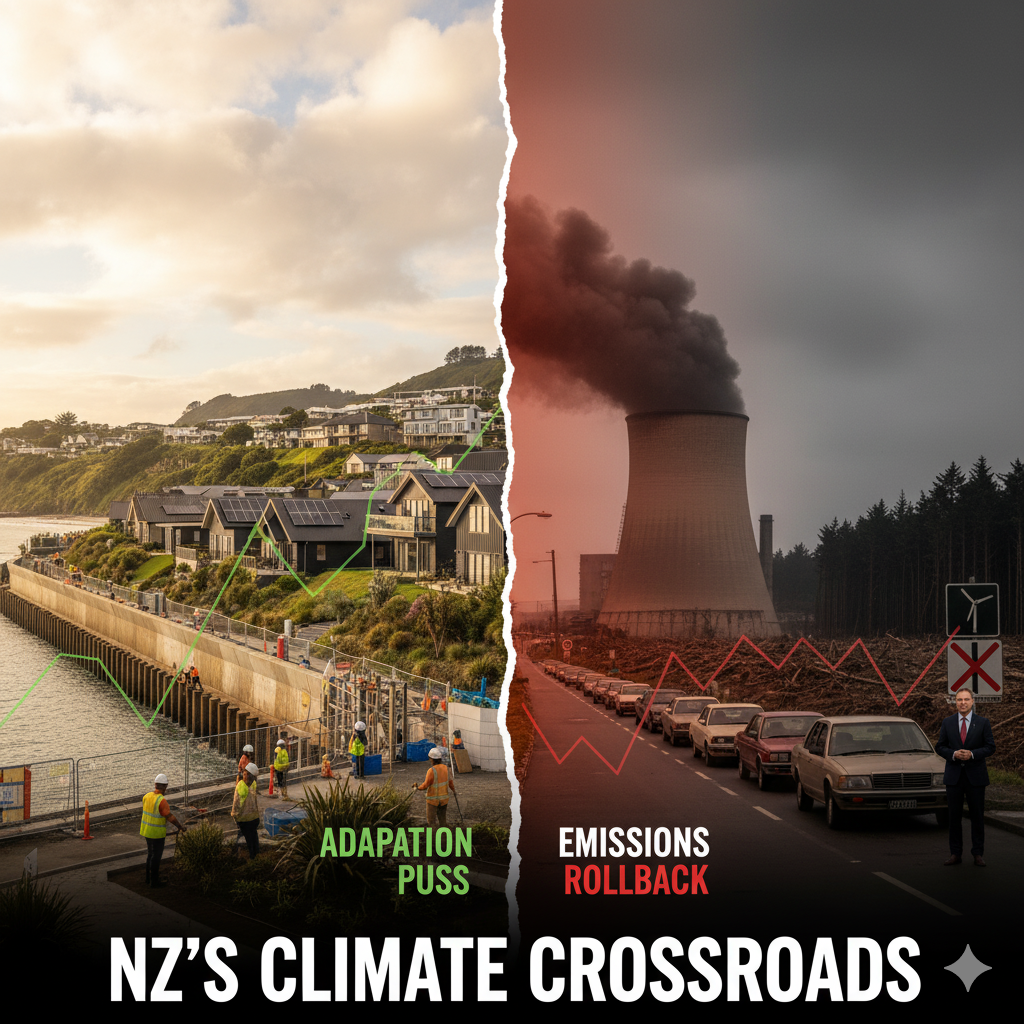
New Zealand’s climate strategy sits at a crossroads. The Government is promoting a new plan to help communities adapt to floods, storms, and sea-level rise. At the same time, it has weakened several policies that cut emissions. Scientists and analysts say the two tracks clash.
The adaptation plan aims to build resilience
Climate Change Minister Simon Watts has launched a National Adaptation Framework. He says it will prepare the country for climate impacts while keeping costs down.
The plan rests on four pillars: share risk information, clarify roles, invest in risk reduction, and agree on how to share costs after disasters. A flagship tool is the National Flood Map due by 2027. It will show where floods are likely now and in the future. Homeowners, developers, and councils can use it to guide planning and insurance decisions.
Councils in high-risk zones must prepare local adaptation plans. Recent floods showed why, says Watts. The aim is to protect people and assets before the next event.
Rollbacks raise credibility questions
Critics say adaptation alone is not enough. They point to the Government’s retreat from key emissions policies.
The biggest change hit the Climate-Related Disclosures (CRD) regime. Introduced in 2021, it required large listed companies and major financial institutions to report climate risks. In 2025 the threshold jumped from $60 million to $1 billion in market value. KiwiSaver and investment scheme managers were exempted. The number of reporting entities fell from 164 to 76. Sustainability experts warn the move sends the wrong signal to investors who want transparency.
Methane targets scaled back
The Government also cut the ambition of biogenic methane targets. The 2050 goal moved from 24–47% below 2017 levels to 14–24%. The Climate Change Commission had urged stronger action.
In its 2025 monitoring report, the Commission warned that current policies risk missing later emissions budgets. The first budget for 2022–2025 may be met, but mostly due to temporary factors. Meeting the 2031–2035 budget and reaching net-zero by 2050 will require faster change. The Commission called for urgent steps: strengthen the ETS, speed the shift to renewables and cleaner transport, and back low-emission farming.
Conservation progress, funding gaps
Practical work continues on the ground. On 25 October 2025, 19 new marine protection areas will take effect in the Hauraki Gulf. The zones aim to protect habitats and rebuild biodiversity.
Yet the Parliamentary Commissioner for the Environment says the national biodiversity strategy still underfunds core threats such as land-use change and introduced pests. Without steady funding, gains may stall.
The cost of doing both
New Zealand needs adaptation and mitigation. Building flood walls while loosening emissions rules risks higher long-term bills. Environmental scientist Dr Helen Farrant puts it simply: “Adaptation without cutting emissions is like mopping while the tap is still running.”
For communities facing erosion, rising premiums, and retreat decisions, the framework offers tools and a process. For markets and international partners, the policy rollbacks raise doubts about the long-term direction.
What to watch next
The world will watch New Zealand’s stance at the next UN climate talks. The test is whether Wellington can pair its adaptation push with credible emissions cuts. Success would show pragmatic leadership. Failure would raise costs for future generations.
References: Climate Change Commission Monitoring Report 2025; Ministry for the Environment, National Adaptation Framework 2025; Parliamentary Commissioner for the Environment, June 2025; Webfit News analysis.