
By Webfit News
For many New Zealanders, the word homelessness creates a particular picture.
Someone sleeping on a footpath.
A person in a doorway.
A rough sleeper carrying their belongings.
But for thousands of Kiwi children, homelessness can look very different.
It can mean sleeping in a car.
Living in a garage.
Moving between relatives’ homes.
Sharing overcrowded rooms.
Or spending winter in a cold, damp space that was never designed to be a permanent home.
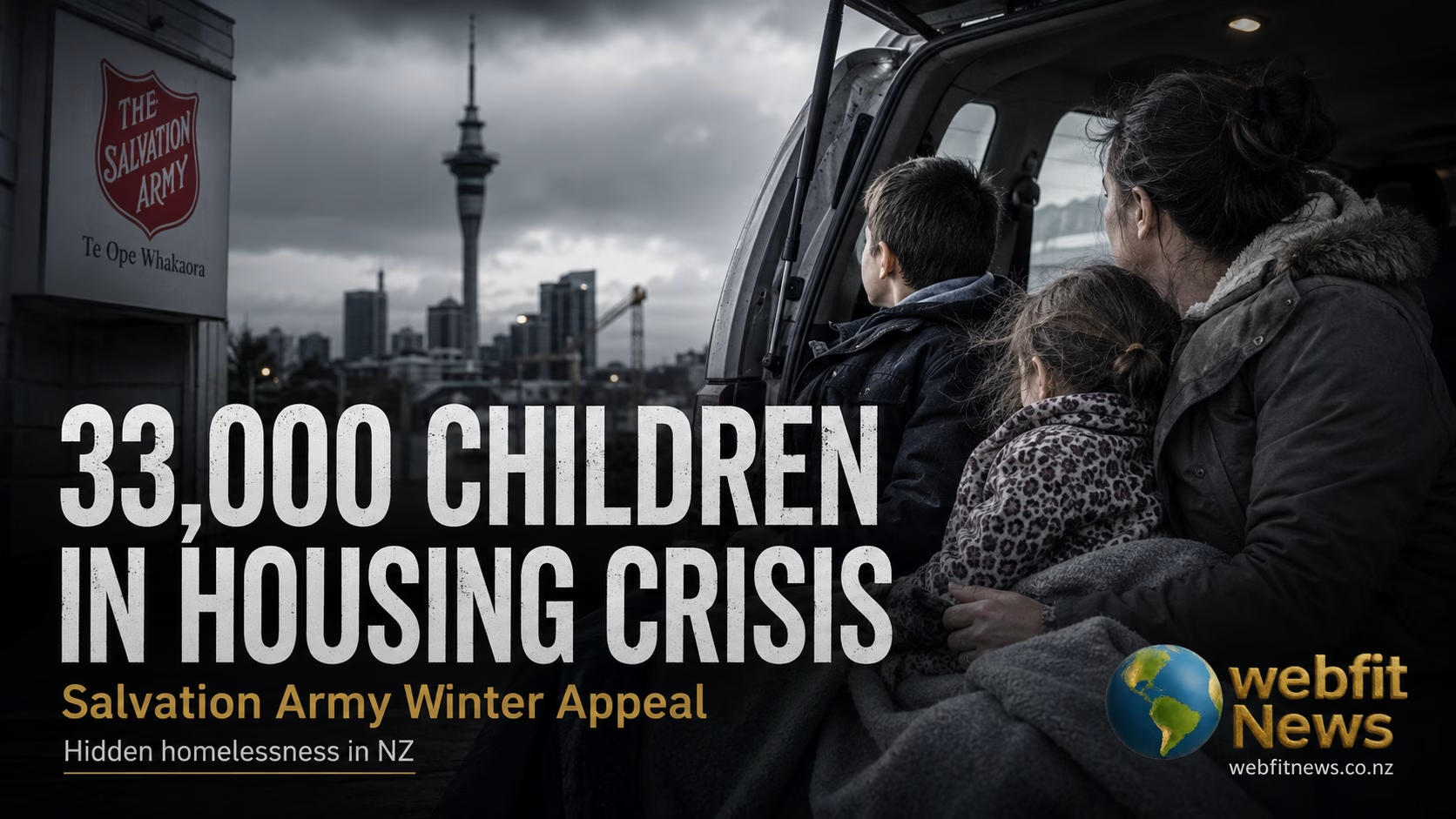
The Salvation Army has launched its 2026 Winter Appeal under the theme “Hope for Homeless Families”, warning that more than 33,000 children are living in severe housing deprivation across New Zealand.
The organisation says more than 112,000 people overall are now experiencing severe housing deprivation.
Those numbers are not simply charity campaign figures.
Stats NZ’s 2023 Census severe housing deprivation estimates found just over 112,000 people were severely housing deprived, an increase of more than 13,000 people compared with 2018.
Stats NZ also reported that children made up a significant share of those affected, including more than 11,000 Pacific children experiencing severe housing deprivation.
The uncomfortable reality is that child homelessness in New Zealand is often hidden.
And that may be exactly why many Kiwis do not realise how serious the problem has become.
What Does “Severe Housing Deprivation” Actually Mean?
This is an important question because the figure of more than 112,000 people does not mean 112,000 people are sleeping on the street.
Severe housing deprivation is a broader official measure of homelessness.
It includes people living without shelter, people staying in temporary accommodation, people sharing severely overcrowded homes and people living in housing without basic amenities.
In previous government housing data, the categories have included people living in improvised or mobile dwellings, temporary accommodation, severely overcrowded shared housing and uninhabitable homes lacking basic facilities such as safe drinking water, electricity, cooking facilities, a shower or a toilet.
That means a child sleeping in a van can be homeless.
A family constantly moving between friends’ couches can be homeless.
A child living in a severely overcrowded house because their family has nowhere else to go can be experiencing homelessness.
Homelessness does not always have a cardboard sign.
Sometimes it has a school uniform hanging inside a van.
More Than 33,000 Children Are Caught in the Housing Crisis
The Salvation Army says more than 33,000 children are living in severe housing deprivation.
Stats NZ’s wider housing research also shows the scale of housing pressure on younger New Zealanders.
Its Housing in Aotearoa New Zealand 2025 report found that more than 320,000 children and young people lived in crowded households in 2023.
That represented almost one in five children and young people.
Crowding and severe housing deprivation are not identical measures.
It would therefore be wrong to describe every child in a crowded household as homeless.
But the figures show how significant housing pressure has become for New Zealand families.
The Salvation Army says many children facing severe housing deprivation are sleeping on couches, sharing crowded rooms or living in cold and damp spaces.
Captain Andrew Wilson, Salvation Army Corps Officer for Wellington South, said too many families were being pushed towards homelessness as living costs placed further pressure on household budgets.
“Too many families and children are facing the heartbreak of homelessness,” Wilson said.
He said families were increasingly being forced to make difficult financial choices between basic needs.
For an ordinary Kiwi family already struggling with rent, groceries, power and transport costs, one major financial shock can create a serious problem.
A job loss.
A relationship breakdown.
An unexpected medical issue.
A rent increase.
A landlord selling a property.
A car repair when the family needs the vehicle to get to work.
The distance between “just managing” and “we have nowhere to stay” may be much smaller than many people realise.
The Story of Jack and Tula Shows How Hidden Homelessness Can Begin
The Salvation Army has shared the story of a family identified as Jack and Tula, whose names have been changed.
The couple and their four children initially moved between the homes of friends and relatives after their housing options ran out.
But each temporary arrangement eventually became unsustainable as space ran out.
The family ultimately began living in their van.
Two of their sons are on the autism spectrum, making the cramped and unstable living environment even more difficult.
Through support from The Salvation Army, the family eventually moved into a four-bedroom social housing home.
Jack described the move as a major relief for the family.
“Words cannot describe the relief of having a roof over our heads. We finally have space to put down roots and start again,” he said.
Their story is important because it challenges a common assumption.
Families do not always move directly from a normal home to sleeping on the street.
Homelessness can happen in stages.
First, a family stays with a relative.
Then a friend offers a couch.
Then someone allows them to sleep in a garage.
Then the family moves again.
Eventually, the informal support network runs out of space.
By the time a family is sleeping in a vehicle, the crisis may have been developing for weeks or months.
Why Stable Housing Matters So Much for Children
A safe home is not simply a roof.
For a child, housing provides routine.
A place to sleep.
A place to do homework.
Somewhere to keep school clothes.
A reliable address.
A kitchen.
A bathroom.
A sense that tomorrow may look roughly like today.
When housing becomes unstable, almost every other part of family life becomes harder.
The Salvation Army says children facing homelessness are more likely to experience poor health and miss school.
Housing instability can also create practical problems that are easy to overlook.
Imagine trying to get four children ready for school from a van.
Where are the uniforms stored?
Where do they shower?
Where is breakfast prepared?
How does a child complete homework?
What happens when the vehicle must move?
How does a parent keep a child’s situation private from classmates?
These are not abstract housing statistics.
They are daily logistical problems faced by real families.
Winter Makes an Already Difficult Situation Worse
The Salvation Army’s appeal comes during winter for a reason.
Cold weather increases the impact of poor housing.
A car is not designed to keep a family warm overnight.
A garage may have no proper insulation.
A damp bedroom can become harder to heat.
Overcrowding can increase pressure on already stretched households.
Families with very limited income may also face another difficult decision.
Heat the home or save money for groceries.
Pay an overdue electricity bill or buy petrol to get to work.
The Salvation Army says its Winter Appeal will support emergency housing, food assistance, budgeting advice and ongoing wraparound support for families.
That wraparound support is important.
Finding someone a room for one night may address the immediate emergency.
It does not necessarily solve the reasons the family entered a housing crisis.
A family may still need help with debt.
Food.
Income support.
Budgeting.
Finding a rental.
Accessing social housing.
Or dealing with health and family issues.
Government research into emergency housing support services published in 2026 found generally positive results from combining housing support with services such as navigators, housing brokers and other tailored assistance.
The evaluation found that support services worked together to address different barriers faced by people trying to move into sustainable housing.
That supports a simple point.
A roof matters.
But helping a family stay housed matters too.
Is New Zealand’s Homelessness Problem Getting Worse?
The latest official severe housing deprivation estimate gives a worrying answer.
Stats NZ estimated that just over 112,000 people were severely housing deprived in 2023.
That was more than 13,000 higher than the comparable 2018 estimate.
There is some positive news elsewhere in the housing system.
Government data shows the number of households in emergency housing reduced significantly from early 2024 to late 2025.
A 2026 Ministry of Social Development evaluation said the number fell from 2,880 households at the end of January 2024 to 459 at the end of November 2025.
That is a major reduction.
But it does not mean homelessness has disappeared.
This is where readers need to understand the difference between emergency housing numbers and severe housing deprivation.
Emergency housing data largely tracks people accessing a particular government-supported accommodation pathway.
Severe housing deprivation is much broader.
A family living in a van may not necessarily appear in emergency housing motel figures.
A child sleeping temporarily with relatives may remain hidden.
A severely overcrowded household may never call itself homeless.
So a reduction in emergency housing use is important, but it cannot by itself tell us how many families are living in unstable or unsafe housing.
That distinction is crucial.
Otherwise, New Zealand risks congratulating itself for reducing one statistic while failing to see families who remain outside the formal system.
What Should You Do If Your Family Has Nowhere Safe to Stay?
For someone reading this article because they are worried about their own housing situation, the most important advice is simple:
Ask for help before the situation becomes completely unmanageable.
The Ministry of Social Development says emergency housing may be available for eligible people who urgently need somewhere to stay that night or within the next seven days.
People seeking emergency housing support can contact Work and Income on 0800 559 009 or visit a Work and Income service centre.
MSD says Emergency Housing Grants can help cover short-term accommodation when a person has an urgent housing need and other options have been explored.
The Salvation Army also provides welfare, food and housing-related support and lists its freephone number as 0800 53 00 00.
Do not wait because you feel embarrassed.
Do not assume another family “needs help more”.
And do not assume sleeping in a car for a few nights means you are not experiencing a housing emergency.
The earlier support services understand what is happening, the more opportunity there may be to explore available options.
How Can Ordinary Kiwis Help?
The Salvation Army is asking New Zealanders to donate to its 2026 Winter Appeal.
Funds raised will support services including emergency housing, food support, budgeting assistance and ongoing support for families trying to regain stability.
People can donate through The Salvation Army’s official New Zealand website or through a local Salvation Army centre.
But money is not the only way communities can help.
Pay attention when a family suddenly starts moving frequently.
Check on relatives who are taking in extra family members.
Do not automatically judge someone living in a vehicle.
Schools, community organisations, faith groups and neighbours may sometimes notice housing instability before a family feels able to openly ask for help.
There is a difference between respecting someone’s privacy and pretending not to notice that they are struggling.
Sometimes a quiet question can matter:
“Are you okay, and do you need help finding support?”
Webfit News Analysis: The 33,000 Children Figure Should Make New Zealand Uncomfortable
New Zealand is a wealthy country.
That does not mean every citizen is wealthy.
It does not mean housing is automatically accessible.
And it clearly does not mean every child has a safe bedroom.
More than 33,000 children experiencing severe housing deprivation is not a fringe social problem.
It is a warning about the condition of the wider housing system.
The problem cannot be solved by charity alone.
The Salvation Army can provide emergency assistance, food, housing support and wraparound care.
Community organisations can help families survive a crisis.
But charities do not set national housing supply.
They do not control rents.
They do not determine social housing capacity.
They cannot fix every shortage of affordable homes.
Long-term solutions require government policy, housing construction, effective social housing, homelessness prevention and support that reaches families before they end up sleeping in a vehicle.
At the same time, saying “this is the Government’s problem” is an easy way for the rest of us to look away.
A child sleeping in a van tonight does not benefit from a five-year political argument about which party caused the housing crisis.
That child needs somewhere warm and safe now.
Both realities can be true.
New Zealand needs structural housing reform.
And families in crisis need immediate help.
The Bottom Line
The Salvation Army’s 2026 Winter Appeal is called “Hope for Homeless Families”.
The name sounds positive.
The numbers behind it are much harder to read.
More than 112,000 people were estimated to be experiencing severe housing deprivation.
More than 33,000 children are caught in that crisis.
Some are in cars.
Some are in overcrowded homes.
Some are moving between couches.
Some are living in spaces that were never meant to become homes.
Many will never be visible on a city footpath.
That does not make them less homeless.
This winter, the most important thing New Zealand can do is stop treating homelessness as something that only happens to somebody else.
Because for tens of thousands of Kiwi children, the housing crisis is not a political debate.
It is where they are sleeping tonight.
References
The Salvation Army New Zealand, “Salvation Army Launches 2026 Winter Appeal as Child Homelessness Crisis Deepens”, 13 July 2026.
Stats NZ, 2023 Census Severe Housing Deprivation Homelessness Estimates.
Stats NZ, Housing in Aotearoa New Zealand 2025.
Te Tūāpapa Kura Kāinga, Ministry of Housing and Urban Development, Severe Housing Deprivation Estimates and Homelessness Indicators.
Ministry of Social Development, Emergency Housing Support Services Evaluation Final Report, 2026.
Ministry of Social Development, Emergency Housing Grants and Housing Support Information.