
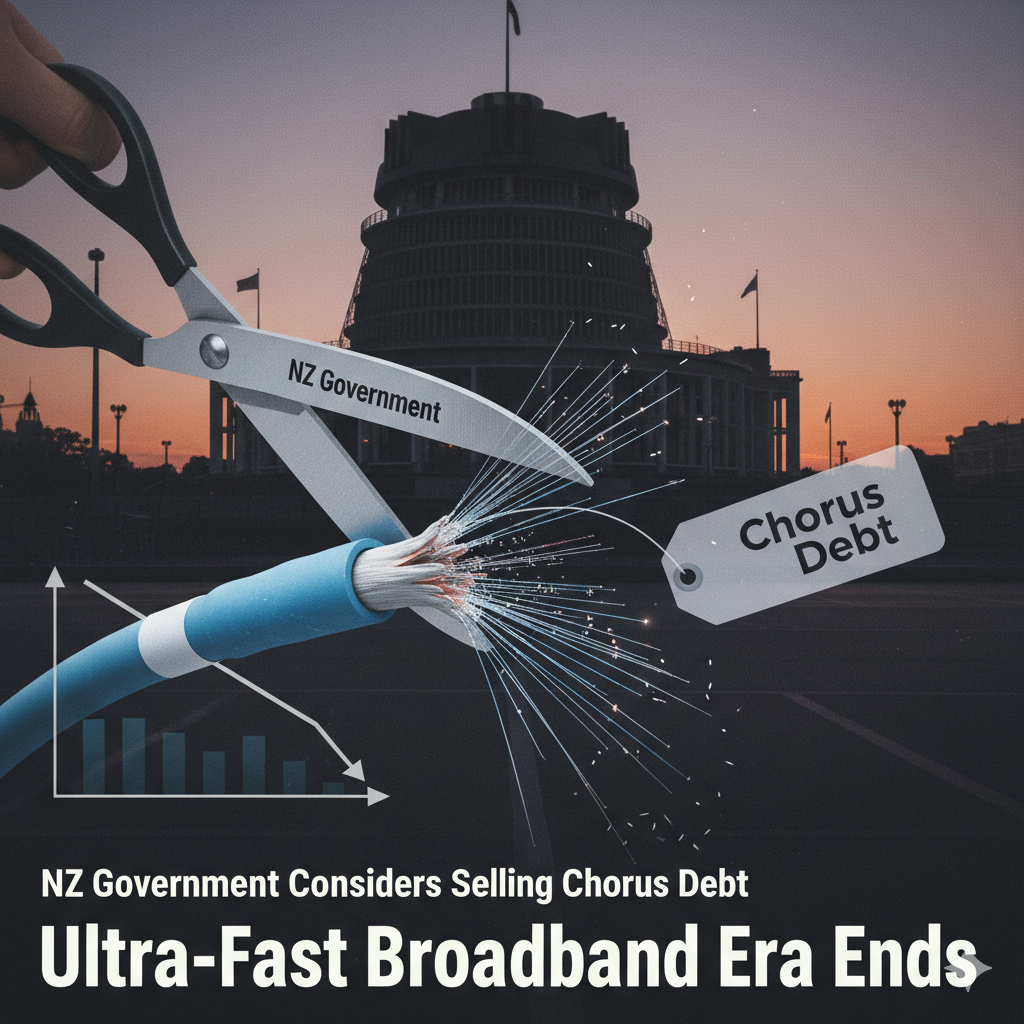
The New Zealand government is reviewing plans to sell more than $1 billion in Chorus debt and equity instruments, a move that would formally end its direct role in the country’s Ultra-Fast Broadband (UFB) programme. Finance Minister Nicola Willis says the sale would free up funds for other infrastructure priorities now that the UFB rollout is complete.
Webfit News has previously reported on the government’s approach to broadband investment and digital infrastructure strategy. In earlier coverage, Labour MP Helen White told Webfit News that any future restructuring of Crown investments in fibre networks “must protect public interests and ensure regional access is not left behind.” Her comments reflected Labour’s ongoing caution about moves that might resemble partial privatisation.
End of an Era for UFB
The government’s UFB programme, completed in December 2022, was one of the largest public–private partnerships in New Zealand’s digital history. It connected millions of homes and businesses to high-speed fibre across the country.
Minister Willis said that with the project now complete, “there is no longer a policy reason for the Crown to own Chorus.” Ownership of Chorus debt and equity securities came through NIFFCo (National Infrastructure Funding and Financing Company), which helped fund the fibre network’s construction.
The securities, originally due to mature in five to ten years, are now being reviewed for sale. NIFFCo is expected to advise the Finance Minister by the end of 2025.
Market Reaction and Political Debate
The proposal has sparked political debate. Labour leader Chris Hipkins criticised the move, accusing the government of selling public investments to address budget shortfalls.
In her interview with Webfit News, Helen White echoed this concern, saying “fibre is not just a piece of infrastructure—it’s part of how we connect education, healthcare, and small businesses to opportunity. Any financial manoeuvre that risks that stability deserves close scrutiny.”
Finance Minister Willis maintains the sale is about efficiency, not ideology. “Selling debt instruments is different from selling state assets,” she said. “It’s a pragmatic move to manage capital better.”
Chorus has stated that any change in ownership of these securities will not affect its operating conditions or customer services.
Analysts and Market Outlook
Industry analysts suggest the sale would have minimal impact on Chorus operations. Commentator Paul McBeth, writing for The Bottom Line, said there is still value in holding the securities but acknowledged that “these were never the family silver.” He added that the government’s balance sheet “isn’t built to wait a decade to extract maximum value.”
Market watchers agree that the sale is likely to proceed smoothly, given the strong demand for long-term infrastructure assets.
Broader Telecommunications Landscape
Eon Fibre Launches DC Direct
Amid policy changes, Eon Fibre has announced DC Direct, a new high-performance network connecting over 30 data centres and 3,500 business sites across New Zealand. CEO Richard Mooney said the system supports technologies like dark fibre, wavelength, and Ethernet, meeting growing enterprise demand from AI and cloud services.
He added that Eon Fibre’s network “is designed for digital enterprises, not mass-market users, offering flexible and scalable bandwidth solutions.”
Commerce Commission Praises Industry Progress
The Commerce Commission has commended mobile operators for improving coverage maps and introducing “exit rights” that let customers switch providers if service quality fails to match advertised coverage.
Retail Service Quality Manager Andrew Young said all providers now use standardised coverage data, making comparisons fairer. “Customers can now leave without penalty if the coverage experience doesn’t meet expectations,” he said.
These updates follow 2024 guidelines issued under the Telecommunications Act, aimed at improving transparency and consumer confidence.
Looking Ahead
The proposed Chorus sale would symbolise the final stage of the Crown’s direct involvement in New Zealand’s fibre revolution. While critics warn it risks repeating past mistakes with asset sales, the government insists it will maintain oversight of the network’s public benefit.
For now, the focus will shift toward maintaining network resilience, expanding rural connectivity, and encouraging private sector investment. As Helen White told Webfit News, “the challenge is making sure efficiency doesn’t come at the cost of equality of access.”
References
- Bill Bennett, Government eyes Chorus debt sale, ending its UFB role, Scoop Media, 21 October 2025.
- Ministry of Finance, NIFFCo Infrastructure Funding Overview, 2025.
- Webfit News interview with Helen White MP, 2024 – “Broadband Access and the Public Good.”
- Commerce Commission, Telecommunications Retail Service Quality Programme, 2024–2025.
- Eon Fibre, DC Direct Product Launch Statement, 2025.