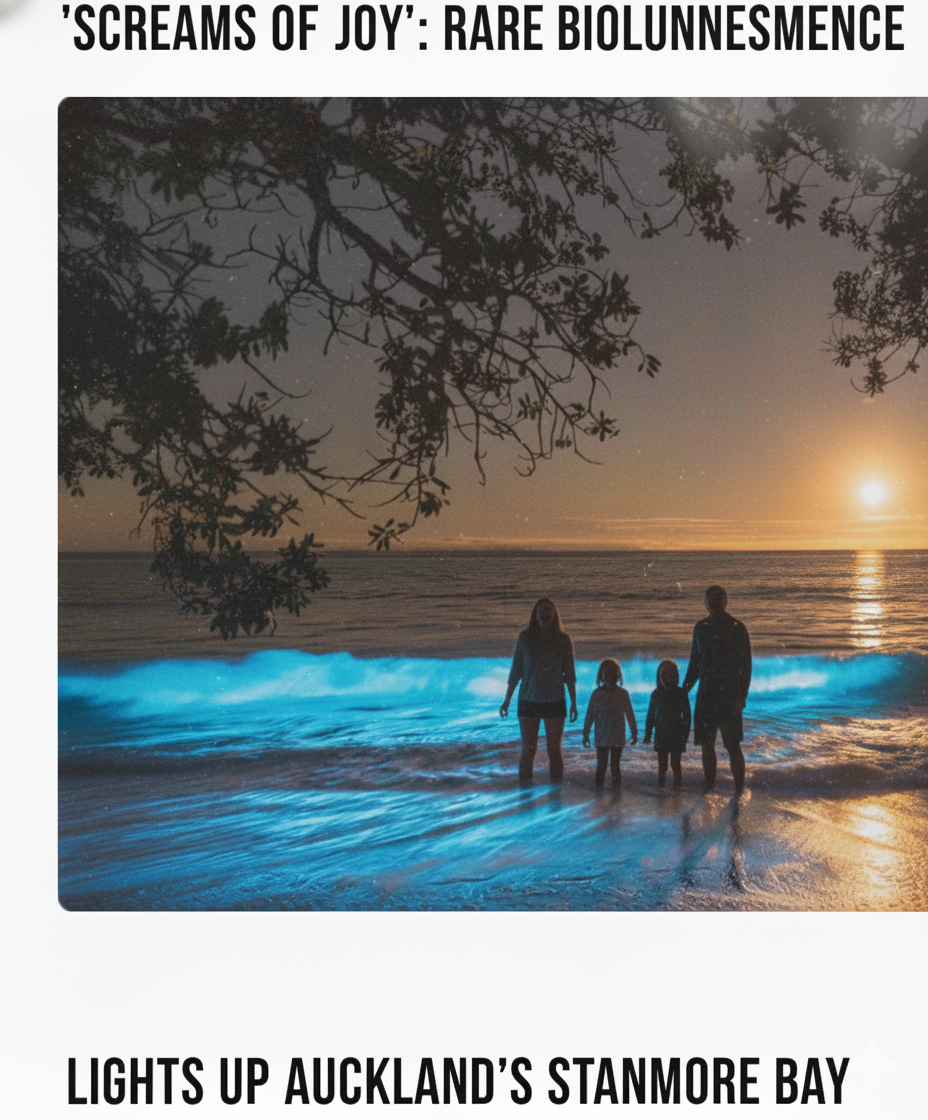
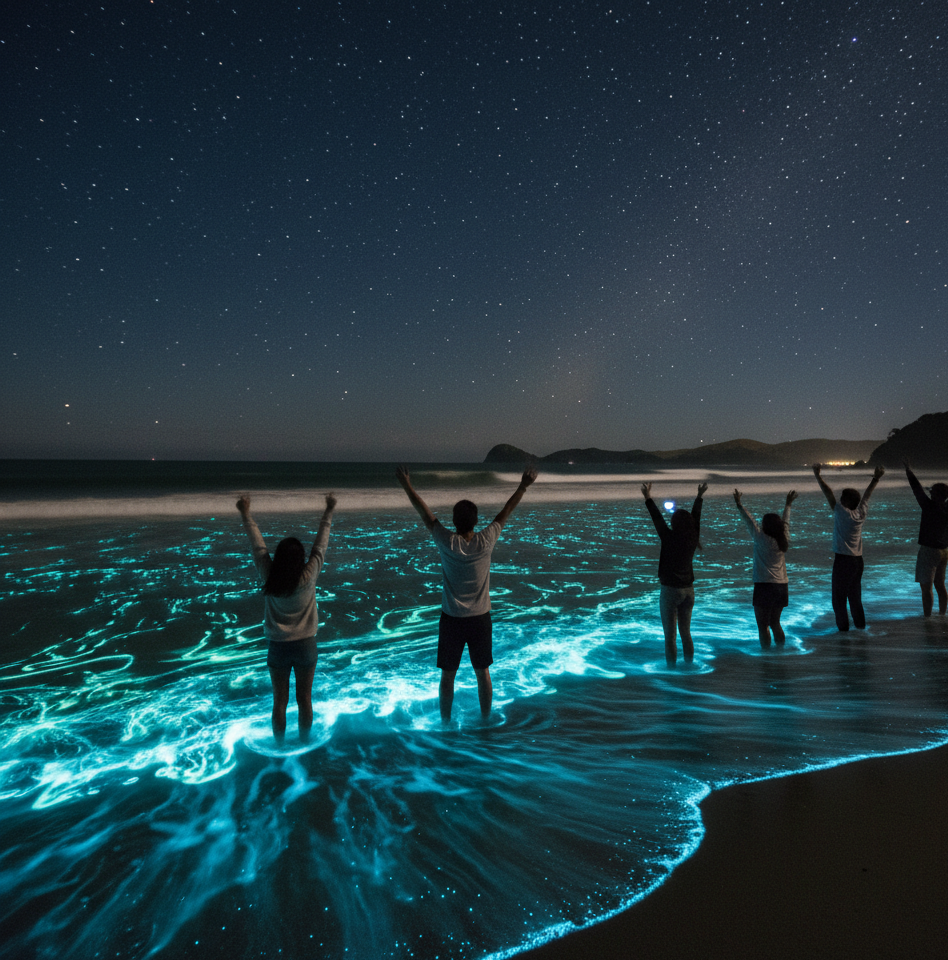
A rare natural light show has left hundreds of Aucklanders in awe after Stanmore Bay glowed bright blue and green on Friday night. The stunning bioluminescence display, described by onlookers as “the best show ever,” drew crowds of families, photographers, and curious locals who rushed to the beach after social media posts spread the news.
Photographer Matthew Davison, who has been tracking bioluminescent blooms for more than a decade, said this was the most vivid display he had ever witnessed.
“Brilliant blue and neon green bioluminescence stretched as far as I could see, illuminating the entire shoreline,” he said. “It was an unforgettable evening, people were cheering, swimming, and laughing as the waves glowed around them.”
What Is Bioluminescence?
Bioluminescence is a natural phenomenon caused by microscopic plankton known as dinoflagellates that emit light when disturbed by movement, such as waves or footsteps. The glow comes from a chemical reaction between luciferin and luciferase, which also occurs in fireflies and some deep-sea organisms.
When ocean conditions are right, usually warm water, calm tides, and nutrient-rich currents, these tiny organisms can produce spectacular nighttime displays of glowing blue or green light along shorelines.
Photographing bioluminescence is difficult, since it needs long exposure and specific camera settings. Davison, who uses a custom satellite tool to detect algal blooms, said he knew something special was coming when he saw a bright red patch near Stanmore Bay earlier that day.
Common Sight in Australia
While rare in New Zealand, bioluminescence is relatively common along Australia’s coastline. Locations such as Jervis Bay in New South Wales, Tasmania’s beaches, and parts of Queensland’s coast are known for regular displays.
In Jervis Bay, glowing waves attract photographers each summer. Australian researchers have mapped bioluminescent “hotspots” where conditions consistently favour algal blooms, such as calm bays with clear, warm water and gentle tidal activity.
Bioluminescence in New Zealand
In New Zealand, bioluminescence is more unpredictable but equally breathtaking when it appears. The phenomenon has been spotted at beaches including Stanmore Bay, Arkles Bay, Orewa, and Tāwharanui in the North Island, and Kaiteriteri and Kaikōura further south.
Friday night’s event at Stanmore Bay drew an estimated 500 people. Families splashed in glowing surf, children laughed as their footprints shimmered, and photographers lined the shore to capture the moment.
“The joy on people’s faces was amazing,” Davison said. “Everyone shared the moment, total strangers were high-fiving and cheering.”
Where to See It in New Zealand
Your best chances are on Auckland’s east coast beaches during warm, calm nights between November and March. Look for areas with gentle waves and low light pollution.
Spots with past sightings:
Stanmore Bay (Whangaparāoa Peninsula)
Arkles Bay and Orewa Beach
Tāwharanui Regional Park
Kaiteriteri Beach (Tasman Bay)
Kaikōura and Akaroa coastlines
Check local community groups and algae maps, since blooms can appear quickly and vanish within a night or two.
Conclusion
The glowing waves at Stanmore Bay were a rare, magical sight. Australia might see these displays more often, but New Zealand’s coastline still delivers unforgettable moments when conditions align. For anyone lucky enough to witness it, the experience is a reminder to look to the night tide with curiosity and wonder.
If you want, I can also remove the meta bits or move them to the end in your preferred format.